they would be bee orchids with the impressive Latin name Ophrys Apifera. Siri 🙂 and 🙂 Selma are so fond of these rather rare flowers because the lips of these orchids tease the male bees. They look like a female bee and their appearance attracts male bees, which then pollinate them. Our two fairies love such a game of disguise. Besides, Selma 🙂 thinks this is a laughing flower with a green silvery coat, as she would like to have one too.
wären sie Bienen-Orchideen oder Bienenragwurz mit dem eindrucksvollen lateinischen Namen Ophrys Apifera. Siri 🙂 und 🙂 Selma sind von diesen ziemlich seltenen Blumen so angetan, weil die Lippen dieser Orchideen die männlichen Bienen necken. Sie sehen nämlich wie eine weibliche Biene aus und locken mit ihrem Aussehen männliche Bienen an, die sie dann bestäuben. Solch ein Verkleidungsspiel lieben unsere beiden Feen. Außerdem meint Selma :-), dies sei eine lachende Blume mit grün silbrigen Mantel, wie sie auch gerne einen hätte.
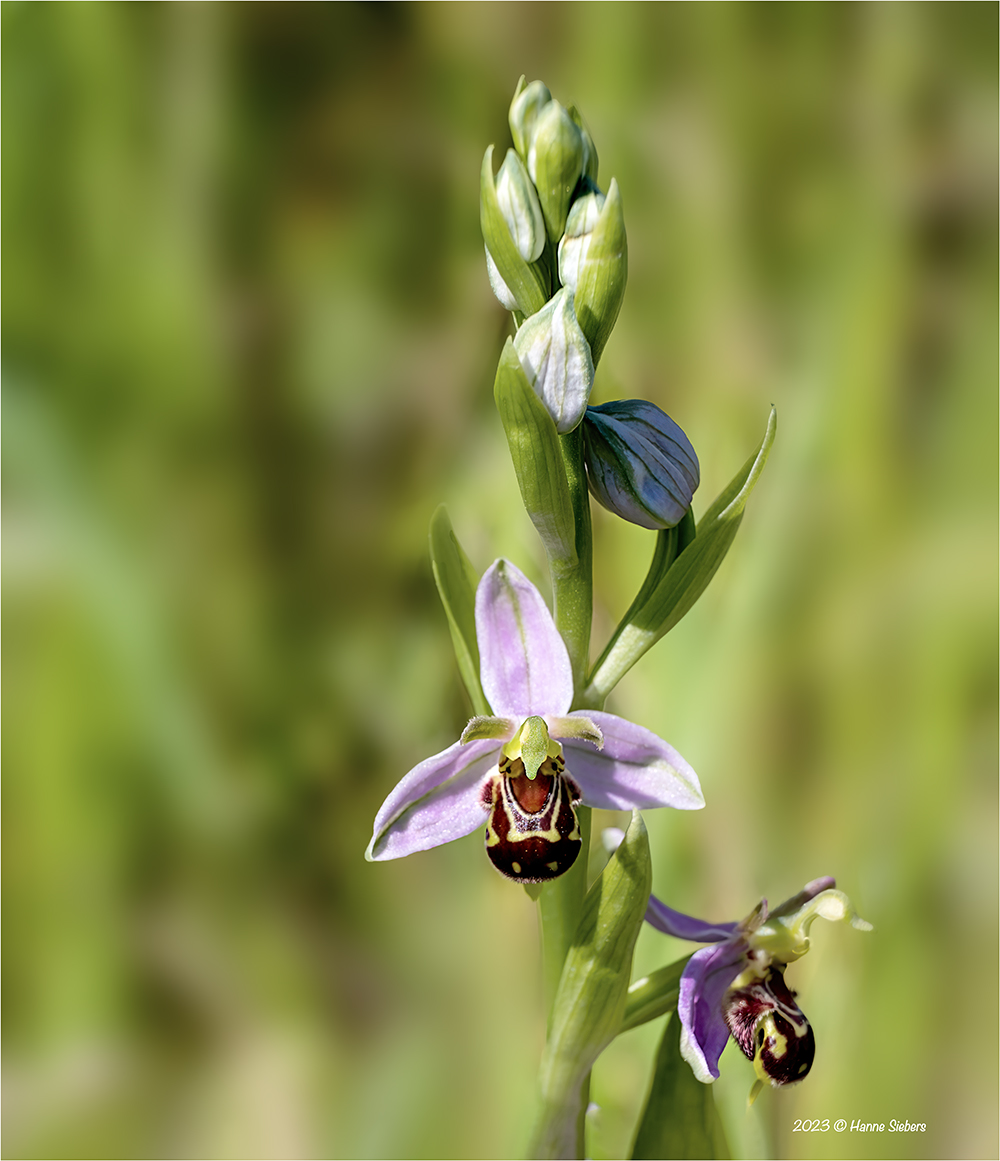
However, all this disguise is for nothing. Unfortunately, here in England we don’t have the right bees to be attracted by such false bees. Because the bees here are too clever, the orchids have no choice but to pollinate themselves. They must still be working on their disguise with the help of evolution to trick our clever bees.
Die ganze Verkleidung ist jedoch umsonst. Leider gibt es bei uns in England nicht die richtigen Bienen, die sich von solchen falschen Bienen anziehen lassen. Weil hier die Bienen zu clever sind, bleibt den Orchideen nichts weiter übrig, als sich selbst zu bestäuben. Da müssen sie wohl mit Hilfe der Evolution noch an ihrer Verkleidung arbeiten, um heimische Bienen zu betören.
When our Bookfayries read Dina’s and Masterchen’s clever books, they found another explanation that seemed also plausible to them. The leaf in the shape of the bee keeps grazing animals from eating it so as not to get stung. The latest explanation is that these orchids secrete a scent that is supposed to attract certain bees that are rare in our country or do not exist at all, which scholars are still arguing about.
Als unsere Buchfeen Dinas und Masterchens kluge dicke Bücher wälzten, fanden sie noch eine andere Erklärung, die ihnen plausibel erschien. Das Blatt in Form der Biene hält grasende Tiere davon ab, sie zu fressen, um nicht gestochen zu werden. Die neuste Erklärung spricht davon, dass diese Orchideen einen Duftstoff absondern, der bestimmte Bienen anlocken soll, die bei uns selten sind oder es gar nicht gibt, worüber sich die Gelehrten noch streiten.
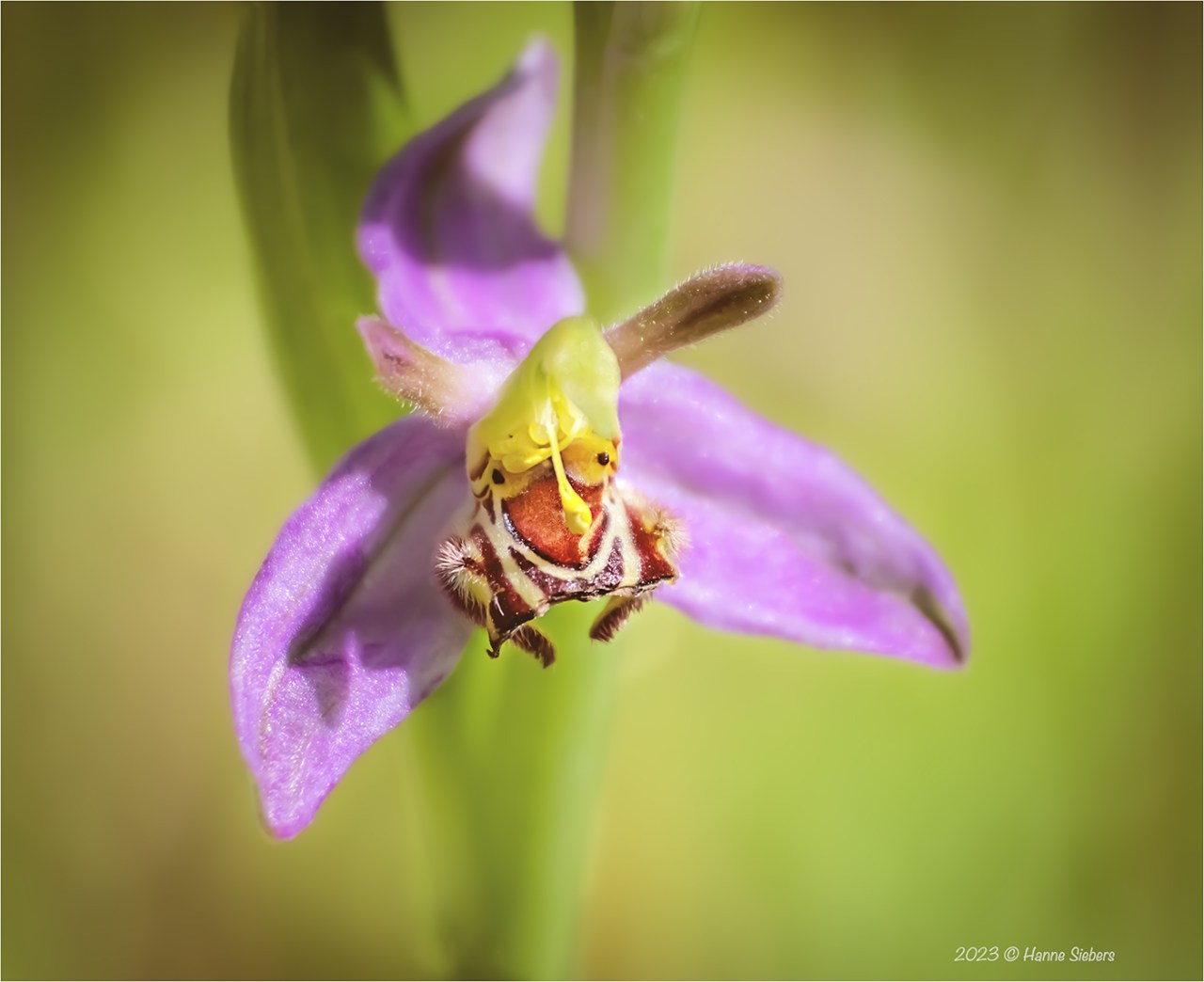
After all, the bee orchids have made it to the flower of idyllic Bedfordshire. But even here in Norfolk, Siri 🙂 and 🙂 Selma found such an orchid close to us in a grassland overlooking the sea. This is also our fairies’ favourite place.
Die Bienen-Orchideen haben es immerhin zur Blume des idyllischen Landes Bedfordshire gebracht. Aber auch bei uns in Norfolk fanden Siri 🙂 und 🙂 Selma solch eine Orchidee, ganz bei uns in der Nähe in einem Grasland mit Blick über das Meer. Das ist auch der Lieblingsplatz unserer Feen.
If you could be a flower, what would you be and why?
Könntet ihr eine Blume sein, welche würdet ihr denn wählen und warum?
With kind regards from the hot and sunny Norfolk coast
Mit lieben Grüßen von der hochsommerlichen Küste Norfolks
The Fab Four of Cley
🙂 🙂 🙂 🙂
.
© text and illustrations, Hanne Siebers & Klausbernd Vollmar, Cley next the Sea 2023
 FabFourBlog
Such lovely photos, and interestiing information about the orchid that was new to me.
If I was a flower, I would like to be a common weed, a Dandelion. Weeds have a bad reputation, but Dandelions have lovely yellow flowers, and incredibly strong roots. They can grow anywhere, even through a crack in concrete. Dandelions deserve more love! 🙂
Love from Beetley, Pete and Ollie. X
LikeLiked by 7 people
Good morning, dear Pete
Thank you very much for your kind comment.
We can well understand that you would like to be a Dandelion. Dandelions look friendly like little suns.
Wishing you a happy weekend
The Fab Four of Cley
🙂 🙂 🙂 🙂
LikeLiked by 1 person
Beautiful flowers, indeed.
LikeLiked by 4 people
Thanks,. dear Timothy.
Have a happy weekend
The Fab Four of Cley
🙂 🙂 🙂 🙂
LikeLiked by 1 person
Also ich wäre dann doch ganz gern ein “Tränendes Herz” (Lamprocapnos spectabilis”, denn zum Einen ist das sehr poetisch, zum Anderen ist es eine romantische und extravagante Schattenpflanze, da halte ich mich im Sommer auch lieber. auf! Was sagt ihr Feen nun dazu? Die Orchidee ist ja auch eine gute Wahl wegen der Verkleidungsorgie. 🎃
LikeLiked by 4 people
Ja, Tränendes Herz ist super-romantisch. Allerdings stehen wir mit dieser Blume auf Kriegsfuß, denn sie will einfach nicht in unserem Garten an welchen Standort auch immer gedeihen. Sie scheint uns nicht zu lieben.
Liebe Grüße vom sonnigen Meer
The Fab Four of Cley
🙂 🙂 🙂 🙂
LikeLiked by 1 person
Ja, Pflanzen können ganz schön zickig sein, ich denke da insbesondere an Rosen. Die sollten bei den Angelsachsen und deren typischen Inselklima eigentlich sehr gut gedeihen. 🌋
Beste Grüsse aus Berlin-Charlottenburg
Ulli
P.S. Heute hier englisches Klima 😱 Morgen aber Hochsommer 😎
LikeLike
Liebe(r) Ulli
Wir haben hier seit Wochen feinstes Wetter wie auch die letzten Jahre. Die Küste Nord-Norfolks gehört zu einem der Trockengebiete Europas. Leider regnet es hier viel zu selten. Das sogen. englische Wetter, wie es z.B. in Krimis zelebriert wird, herrscht an der Westküste, die ziemlich feucht ist. Die Ostküste liegt im Regenschatten.
Rosen gedeihen hier problemlos. Wir haben etwa zehn verschiedene Sorten in unserem Garten, David Austen Rosen, Charlotte Jekyll Rosen und andere. Die Rosen von David Austen sind besonders zu empfehlen. Er hat auch den dicken Klassiker über Rosen geschrieben, das Standardwerk.
Übrigens haben wir vor Jahren einige Zeit in Norfolk und Berlin gewohnt (auf dem Fichtenberg oberhalb der U-Bahn Rathaus Steglitz). Im Winter waren wir oft in Berlin, da es hier an der Küste Nord-Norfolk viel zu mild ist. Rein maritimes Klima, es gibt selten Frost und seltenst Schnee.
Liebe Grüße vom sonnigen Meer
The Fab Four of Cley
🙂 🙂 🙂 🙂
LikeLiked by 2 people
Very clever, and pretty, orchids. Thanks for sharing.
LikeLiked by 4 people
Dear Brad
you are very welcome.
Wishing you a wonderful weekend
The Fab Four of Cley
🙂 🙂 🙂 🙂
LikeLiked by 1 person
It seems the would-be deceiver deceived itself in England, where the right kind of bees rarely arrive.
LikeLiked by 2 people
Good morning, dear Steve
it’s funny, isn’t it?
Keep well
The Fab Four of Cley
🙂 🙂 🙂 🙂
LikeLike
I love plants and flowers! Lovely image.☺️
LikeLiked by 3 people
Dear Seyi
thanks a lot 🙏🙏
Enjoy the weekend
The Fab Four of Cley
🙂 🙂 🙂 🙂
LikeLiked by 1 person
I think lavender.
Calming and strong.
Such a special post.
LikeLiked by 3 people
Dear Sandy & Roy
we love lavender as well. Our garden is full of different lavenders. Norfolk is famous for its lavender. A lot of people have lavender hedges here.
Thanks and cheers
The Fab Four of Cley
🙂 🙂 🙂 🙂
LikeLiked by 2 people
Dear Fab Four
Visiting Norfolk during lavender season will be on our list. There was a field in Greece starting to bloom but not ready for picking. Thanks for telling us.
Sandy and Roy.
LikeLiked by 2 people
Dear Sandy and Roy
there is the Norfolk Lavender Centre at Heacham that’s not far from Sandringham in Norfolk, the King’s place. There are big fields of different kinds of lavender. All over Norfolk there is lavender everywhere.
In our garden the lavender just starts getting its colour.
Happy visiting Norfolk
The Fab Four of Cley
🙂 🙂 🙂 🙂
LikeLiked by 1 person
Dear Fab Four
Thank you once again for your useful information. All so good to know.
LikeLiked by 1 person
That was delightful. How do they survive if the bees are too clever? I may have to research this!
LikeLiked by 4 people
Dear Jacqui,
they practise the magic of self-pollinating. Clever, isn’t it?
Wishing you a wonderful weekend
The Fab Four of Cley
🙂 🙂 🙂 🙂
LikeLiked by 1 person
Lovely photographs!
LikeLiked by 4 people
Thank you 🙏🙏
All the best
The Fab Four of Cley
🙂 🙂 🙂 🙂
LikeLiked by 1 person
Lovely orchids! I would be a daisy. They grow in many places and always look so happy. 🙂
LikeLiked by 3 people
Dear Mermaid,
daisies are great. We don’t mind them in our lawns, but in flower beds they are a pest as the spread enormously.
Thanks. Wishing you a happy weekend
The Fab Four of Cley
🙂 🙂 🙂 🙂
LikeLiked by 1 person
Die Bilder eurer Bienen-Orchideen sind wunderschön. Davon lasse ich mich gerne verzaubern.
Wenn ich eine Blume sein sollte, würde ich mich schwer tun bei der grossen Vielfalt. Vielleicht wählte ich den blauen Mohn, den kleinen Augentrost oder die sanfte Schachbrettblume …
Einen lieben Gruss nach Norfolk,
Brigitte
LikeLiked by 3 people
Guten Morgen, liebe Brigitte,
unsere Gegend wird ‘Poppyland’ genannt (nach einem Roman von Clement Scott von 1894). Allerdings gibt es hier nur roten Mohn, den aber in Hülle und Fülle. Jetzt haben wir gerade die Mohnzeit.
Danke fürs Kommentieren.
Wir wünschen dir ein rundum feines Wochenende
The Fab Four of Cley
🙂 🙂 🙂 🙂
LikeLiked by 1 person
I would be a bleeding heart because I have my heart on my sleeve.
LikeLiked by 3 people
Dear Marie
thank you very much for commenting.
Bleeding Heart is so romantic …
Have a happy weekend
The Fab Four of Cley
🙂 🙂 🙂 🙂
LikeLiked by 2 people
I enjoyed this post on a flower that I had not known before. As long as they can self-pollinate, things may be okay. Thanks again, F4oC.
LikeLiked by 4 people
You are very welcome, dear John.
Thanks for commenting
The Fab Four of Cley
🙂 🙂 🙂 🙂
LikeLiked by 1 person
😊
LikeLiked by 1 person
Beautiful orchids
LikeLiked by 3 people
Indeed, they are.
Thanks for commenting.
All the best from Cley to Kathmandu
The Fab Four of Cley
🙂 🙂 🙂 🙂
LikeLiked by 2 people
My dear friends,
I’m happy to see that the sun has finally reached the coast of North Norfolk!
I have tried to find a Bee Orchid in various woodland for years and was not successful so far.
Actually, your specimen is so cute, think it should be called the Teddy Bear Orchid!
My choice of flower would be the charming white dryas –
Dryas octopetala, the eight-petal mountain avens, is an Arctic–alpine flowering plant in the family Rosaceae. It is a small prostrate evergreen subshrub forming large colonies. The specific epithet octopetala derives from the Greek octo ‘eight’ and petalon ‘petal’, referring to the eight petals of the flower, an unusual number in the Rosaceae, where five is the normal number. It grows in Arctic Norway and is also the national flower of Iceland. The genus was named after the Dryades, the wood nymphs of Greek mythology. In ancient Greek, the word “drys” meant a large tree, in particular, the “oak tree”. And indeed, the form of Dryas leaves is like a smaller version of oak leaves. I think I like it so much because it will grow as far north as there is land and it symbolises longevity, purity and innocence. 😉
Cheers! Talk to you soon.
Klem
Per Magnus
LikeLiked by 3 people
Dear Per Magnus,
thanks a lot for all the info about Dryas octopetala.
Siri 🙂 and 🙂 Selma are related to the nymphs. But there are only two Bookfayries but an endless number of nymphs.
We’ll phone at the weekend.
With lots of love from the sunny sea.
The Fab Four of Cley
🙂 🙂 🙂 🙂
LikeLike
Fab Four of Cley,
A lovely story about Siri, Selma nd the bee orchid. Thank you. I never knew about it before.
I thought about it and figured, if I were a flower, I’d be a weed. Perhaps a dandelion. You could make great wine out of me or let me go to seed and I’d fly away with the wind!
Have a terrific weekend, my friends!!
GP
LikeLiked by 3 people
Thank you very much, dear GP
Siri 🙂 and 🙂 Selma like to make these Dandelion seed fly by blowing them away. They are so light and fly like little parachutes.
Concerning Wikipedia you can find these orchids on the American continent too. But they are rare.
Wishing you a terrific weekend as well. We’ll go to a concert tonight
The Fab Four of Cley
🙂 🙂 🙂 🙂
LikeLiked by 2 people
I hope you had a wonderful time!
LikeLiked by 1 person
Indeed, we had! It was a lively concert.
LikeLiked by 1 person
Terrific!!
LikeLiked by 1 person
Orchids are so beautiful. One of the things I love about them is that there are so many varieties and they each have something unique about them.
LikeLiked by 3 people
We absolutely agree, dear Anneli.
Thanks for commenting.
Wishing you a wonderful weekend
The Fab Four of Cley
🙂 🙂 🙂 🙂
LikeLiked by 1 person
Have a great weekend yourselves, KB.
LikeLiked by 1 person
We have had a GREAT weekend, brilliant weather, fine concert, tasty food, and a good book 🙂
LikeLiked by 1 person
Love these orchids, wonderful photographs! And a most interesting post
LikeLiked by 3 people
Good morning, dear Sue,
thanks a lot for your kind words 🙏🙏
Have a happy weekend
The Fab Four of Cley
🙂 🙂 🙂 🙂
LikeLiked by 2 people
Have a great weekend yourselves! 😊😊
LikeLiked by 2 people
Thank you 🙏🙏
We go to a concert tonight. That will be lovely.
LikeLiked by 1 person
What’s the concert? Have a good evening
LikeLiked by 1 person
The Lucy Cavendish Singers will perform in our Church ‘The Rose of Jericho’ with piano and double bass. Actually, we have no idea what it is about. We suppose it will be meditative music.
LikeLiked by 1 person
I rather think it will be….😊😊
LikeLiked by 1 person
Some piece were absolutely great. They performed one piece “Frobisher Bay” (it’s in the Arctic Ocean/Nunavut) by James Gordon which transported the Arctic mood perfectly well and “Trilo” a traditional Swedish song used by fishermen’s wives to welcome and guide their men back from the sea through mist.
LikeLiked by 1 person
Sounds wonderful…and I ‘ve heard of Trilo, wonder if I can find it on Spotify or Apple Music…..
LikeLiked by 1 person
Dear Sue
The highlight of ‘Trilo’ was that the singers were positioned at different places in the church and sang loudly and intensely from different directions.
LikeLiked by 1 person
Oh, brilliant, that would be so atmospheric
LikeLiked by 1 person
I can see why the Bookfayries are so enchanted, and yes a lovely colour for a cloak. I’d be a daisy. Daisies are open and friendly and sleep at night. Perfect.
LikeLiked by 3 people
Dear Jude,
after Siri 😉 and 🙂 Selma have read your comment they want to be Daisies as well.
With lots of love from us to you
The Fab Four of Cley
🙂 🙂 🙂 🙂
LikeLiked by 1 person
Sunflower. I like to be a head above the crowd so I can see all around. I also like the sun.
LikeLiked by 3 people
Good morning, dear David,
we once lived in a town where every year at autumn people came with their sunflowers to the market place. The one who had the tallest sunflower got a price. This was celebrated as a big Sunflower Festival.
Wishing you all the best
The Fab Four of Cley
🙂 🙂 🙂 🙂
LikeLiked by 2 people
Extraordinary, aren’t they? Good to know they can be found in so many places.
LikeLiked by 3 people
Dear Jo
One one hand they can be found on every continent, on the other hand they are quite rare. They are quite unpredictable a s well. One year you find them at one place but next year they are gone.
Thanks a lot.
Have a happy weekend
The Fab Four of Cley
🙂 🙂 🙂 🙂
LikeLike
We orchid hunt every year, between January and March, Klaus. It’s a highlight of the season. All the best to you all 🤗🩵🩵🩵🩵
LikeLiked by 1 person
Hi Jo
We suppose you know a lot about orchids – much more than we do.
Keep well, happy orchid-hunting
The Fab Four of Cley
🙂 🙂 🙂 🙂
LikeLike
I only know what I like in this wonderful world of ours, Klaus. So lucky to be here 💗💗💗💗
LikeLiked by 1 person
Don’t we all just know our world?
LikeLiked by 1 person
I can see why they’d like to be orchids. We recently visited Longwood Gardens in Pennsylvania and saw more types of orchids than I’d seen before. If I were a flower? Hmmm. There are so many beautiful choices. Perhaps a wild iris? Probably some sort of wildflower.
janet
LikeLiked by 3 people
Good morning, dear Janet,
there are such a lot of different orchids. 28.000 species of orchids exist, amazing, isn’t it?
We love the blue Siberian Irises and the brown ones with yellow insides. We have both our garden. They are easy to grow.
Keep well
The Fab Four of Cley
🙂 🙂 🙂 🙂
LikeLiked by 1 person
Amazing photos, they look so beautiful!
LikeLiked by 3 people
Thanks you very much, dear Ute.
This orchid grows just half an hour’s walk from our home. Dina got a hint from one of the wardens of the nature reserve.
Happy weekend
The Fab Four of Cley
🙂 🙂 🙂 🙂
LikeLiked by 1 person
Lovely choices!
LikeLiked by 3 people
Thanks, dear Cindy 🙏 🙏
Enjoy the weekend
The Fab Four of Cley
🙂 🙂 🙂 🙂
LikeLike
The photographs are exquisite! I find that bees have a mystical quality. This is a wonderful post that reminds me that life is about connections. Without flowers, bees would struggle to survive, and without bees, many plant species would struggle to reproduce. Thank you, my dear friends, The Fab Four of Cley, for add a beautiful thought for my day. Sending hugs and more hugs.
LikeLiked by 3 people
Good morning, dear Rebecca,
thanks a lot.
Everything is connected with everything in nature but sometimes plants like these Bee-Orchids can cheat. We think that’s very clever. They are self sufficient and can stand for themselves. They are extremely powerful by outsmarting nature as orchids usually are depending on insects for pollinating.
With lots of love 🥰🥰 and 🤗🤗 hugs from the sunny sea
The Fab Four of Cley
🙂 🙂 🙂 🙂
LikeLiked by 2 people
I have often wondered whether we are the most advanced creature that walks this world. I really enjoyed this post!!!
LikeLiked by 1 person
Well, dear Rebecca, that’s relative. From our point of view we are but from the point of view of plants or animals it might be different.
Thanks and big hugs
The Fab Four of Cley
🙂 🙂 🙂 🙂
LikeLiked by 1 person
It seems sad there are no bees drawn to these lovely orchids. How do they pollinate themselves ? If u was a flower I would be aa gardenia because I love their scent.
LikeLiked by 3 people
Dear Anne
they are self-pollinating. How they do that we don’t understand but our clever Siri 🙂 is researching it in our library.
You are right the scent of a flower makes it attractive too. You are the first who mentions this here.
Happy weekend
The Fab Four of Cley
🙂 🙂 🙂 🙂
LikeLiked by 1 person
As a child I was attracted to Snapdragons (Antirrhinum majus). I’m not sure I would want to be called a dragon, though.
LikeLiked by 3 people
Dear Gwendoline
we love that you can cut snapdragons and they come again. Well, dragons bring luck in the Chinese world. Following Artemidoros they own treasures and are rich beings. In children’s books they are often jolly beings. All in all we don’t mind dragons.
It was christianity and especially Jacobus a Voragine who discriminated dragons.
Thanks for your comment.
Have a happy weekend
The Fab Four of Cley
🙂 🙂 🙂 🙂
LikeLiked by 2 people
Well in that case, I’ll follow my first naive instinct and be a (snap)dragon!
LikeLiked by 2 people
Be a dragon with pride 🙂
LikeLiked by 2 people
Very interesting that the bee orchids self-pollinate. It does look like a bee. In Australia, we have many orchids that are pollinated by one particular insect. They attract a pollinator by posing as a female of that species. If I had to chose which flower to be, I think I would choose the critically endangered button wrinklewort. The flower is so delicate, like filigree. Or maybe a sun orchid. Thank you for the great post, Fab Four. I too am a fan of natural grasslands and the lovely forbs that occupy them.
LikeLiked by 3 people
Hi, dear Tracy,
Siri 🙂 and 🙂 Selma found out that all the other orchids are pollinated by insects. It seems to be that the Bee Orchid is the only self-pollinating orchid. They also found out that Button Wrinklewort exists in Australia only. We love its bright yellow colour 🙂
We have a lot of grassland here that is grazed by cattle during the summer.
Thank you very much for making us aware of the Button Wrinklewort.
Wishing you all the best
The Fab Four of Cley
🙂 🙂 🙂 🙂
LikeLiked by 1 person
The only one! How very inventive. I am glad I could share my favourite flower with Siri and Selma too.
LikeLiked by 2 people
Especially our dear Selma loves to learn about new flowers for her.
LikeLiked by 1 person
My dear friends,
wow, what a great flower! Beautiful.
I not that good with flowers. My favourite plants are the Spider Plant (chlorophytum comosum) and the Money Plant (Crassula ovata). Both are very easy to keep what is important for me. Johann Wolfgang von Goethe loved the spider plant which is mentioned in “Das Märchen” (‘The Green Snake and the Beautiful Lily’). I once read that is good for the climate of your bedroom to have a spider plant in there.
I hope you are well and you had a perfect holiday. I am living in my stuga right now. Very relaxing.
With lots of hugs 🤗 🤗 🤗 🤗 for all of you.
Take care
Annalena 🙂
LikeLiked by 3 people
Dear Annalena,
we love Money Plants as well for the same reason.
We noticed something strange. As we had such sunny and warm weather we put them out on our terrace. After a couple of days the leaves turned red. Our clever Bookfayries googled it and found out that Money Trees can get sun burned. We immediately put them in the shadow under our fig tree. Everything is fine now.
We had a great holiday. The ideal mixture of culture, nature, and driving through amazing landscapes of the Yorkshire moors and dales.
Enjoy your stuga
We’ll phone
The Fab Four of Cley
🙂 🙂 🙂 🙂
LikeLiked by 2 people
We have our own orchid that’s a bit of a trickster: the so-called grass pink. The orange and yellow hairs that look so much like they’re loaded with pollen actually aren’t; they’re only there to tempt bees into visiting. Actual pollination takes place in a different way when the disappointed bee leaves the flower. I was entranced by this native of yours. It certainly does look like a bee is clinging to the bloom. It also reminded me of the Lady’s Slipper, which I just learned also belongs to the orchid family.
As for your question about which flower identity I’d choose: that was hard. I finally decided that it would be our white prickly poppy. It has gorgeous, large white flowers, is beloved of pollinators, and is so prickly that no one ever plucks it to be part of a bouquet. It blooms for months and is resistant to disease and drought — what could be better?
LikeLiked by 3 people
Good afternoon, dear Linda,
as we live in ‘Poppyland’ we found that white prickly poppy interesting. It doesn’t grow in Europe. With it prickly bits it avoids being eaten like the bee orchid with simulating a bee. That it is resistant to disease and drought is ideal.
We had to look up the grass pink as well and found out that they stand for fertility. But actually every orchid stand for fertility as ‘ορχιδέα’ means testicle.
Thank you for commenting
The Fab Four of Cley
🙂 🙂 🙂 🙂
LikeLiked by 2 people
Beautiful flower with a fascinating story.
LikeLiked by 3 people
Thank you very much, dear Jennie 🙏
Wishing you a relaxing weekend
The Fab Four of Cley
🙂 🙂 🙂 🙂
LikeLiked by 1 person
You are welcome. Happy weekend!
LikeLiked by 1 person
I love orchids and have visited so many orchid gardens and shows, that I recognised these. Beautifully photographed! I can easily see why they are popular with the faeries too. If I could be a flower, I think I would be a Platanthera bifolia, commonly known as the lesser butterfly-orchid. It is their time now here in Skåne, and beautiful nights I walk out in the meadows and forest where I know they are waiting for me – sending their wonderful scent and for the stately white flower gleaming in the dusk.
LikeLiked by 3 people
Dear Ann-Christine,
thank you so much for your kind words.
We didn’t know much about orchids but we read a lot for this post. So we know that the the lesser butterfly orchid is important for the biodiversity. It’s uncommon in England but not rare. We suppose we saw it in the wild. The scent of a flower is important for us too for liking it or not.
Wishing you a wonderful weekend
The Fab Four of Cley
🙂 🙂 🙂 🙂
LikeLiked by 1 person
Thank you. Orchids are interesting. Many people don’t know there are wild orhids in the nordic countries.
LikeLiked by 1 person
We didn’t know that either.
LikeLike
Now this post, my dear Klausbernd, makes me think about us males: aren’t we indeed drawn to them by attractive females, and then – forgive my naughty thoughts – intend to pollinate them? 😉 And what about the females when no male is around? Well, I wasn’t thinking of self-pollinization here, but of other behaviour. I believe you know what I’m thinking of! 😉
But now, on a more serious note: fantastic pictures again by Dina/Hanne!
All the best from Texas under a heat spell [up to around 40 degrees for the next 10 days],
Pit
LikeLiked by 3 people
Dear Pit,
well, sexual attraction makes the world go round 😉 You can read good old Freud like this.
Fortunately there are men and women around. Self-pollination is boring, isn’t it 😉
We like your pictures and stories from Ireland 👍
Here it’s quite hot too, well, for our part of the world. The last week we had every day 35 degrees and above but today it’s a little bit cooler.
Keep well
The Fab Four of Cley
🙂 🙂 🙂 🙂
LikeLiked by 1 person
Glad you like my Ireland pictures, dear Klausbernd.
LikeLiked by 1 person
Die sind immer informativ, lieber Pit.
LikeLiked by 1 person
Freut mich!
LikeLike
Das Blatt in Form der Biene hält grasende Tiere davon ab, sie zu fressen, um nicht gestochen zu werden.
Das scheint plausibel.
Aber ein Punkt ist ja immer, daß solche “Erfindungen” der Natur in einer Umgebung, sprich Coexistenz, gediehen, die es jetzt vielleicht nicht mehr gibt.
Zur Zeit der “Erfindung” komnnte man davon ausgehen, daß zig Millionen Jahre lang die Habitate gleich bleiben würden – und wenn nicht, dann halt Pech.
LikeLiked by 2 people
Lieber Gerhart
Genau, so ist es. Die Evolution hinkt der Realität selbst im Zeitalter der Beschleunigung stets etwas hinterher.
Mit lieben Grüßen von der hochsommerlichen Küste
The Fab Four of Cley
🙂 🙂 🙂 🙂
LikeLiked by 1 person
Dazu passt:
Ein Schmetterlingsexperte an der Uni klagtew mir einmal, daß ein bestimmter Falter kaum mehr das Habitat vorfinden kann, das er brauche. Man müsste es also schaffen!
“Wer ihn einmal fliegen hat gesehen…” sagte er. Ich kann das nachvollziehen, weil manche Insekten fürwahr ein ganz eigenartiges Fliegen vollführen.
Liebe Grüsse aus Ufr
LikeLiked by 1 person
Liebe Fab Fours,
danke für Eure schöne Betrachtung und Vorstellung der Bienen-Orchideen. Wie viele Wunderwerke uns die Flora schenkt.
Aus dem Garten der Kindheit mag ich viele Blumenarten. Besonders gefällt mir die Kokarde – Gaillardia -, weshalb ich sie auch zu meinem Profil-Foto gewählt habe.
Gute Mitsommertage
und herzliche Grüße
Bernd
LikeLiked by 2 people
Lieber Bernd,
für uns war es das erste Mal, dass wir diese Orchidee gesehen haben. Naja, wir sind alle Großstadtkinder gewesen. Die einzige Blumen, die wir besser kannten, waren die Topfpflanzen von der Fensterbank.
Auch dir eine wunderschöne Mitsommerzeit.
Liebe Grüße von der sonnigen Küste
The Fab Four of Cley
🙂 🙂 🙂 🙂
LikeLiked by 1 person
Danke für die wunderschönen Fotos und die interessanten Erklärungen.
Wollte ich eine Blume sein? Ich weiß nicht – vielleicht lieber so ein kuscheliges Moospolster. Aber nur wenn es feucht genug ist 😉
Liebe Grüße
Belana Hermine
LikeLiked by 2 people
Guten Tag, Belana Hermine,
auf Moos sind wir gar nicht gekommen. Das ist eine gute Idee. Leider ist es in unserer Gegend zu trocken.
Danke für deinen Kommentar.
Mit herzlichen Grüßen vom sonnigen Meer
The Fab Four of Cley
🙂 🙂 🙂 🙂
LikeLiked by 1 person
Die Fotos und die Betrachtungen dazu lassen mich gerade über die Beratungen zur Green Day-Agenda in Brüssel nachdenken. Ob die Politiker, die dort gerade auf die Bremse treten, wohl je wildwachsende Orchideen gesehen und sich über diese (und etliche andere) wirklich Gedanken gemacht haben? Wieviele Pflanzen und Insekten sterben währenddessen aus, während wir, die Menschen, doch die Möglichkeit hätten, daran etwas zu ändern?
Könnte ich wählen, welche Blume ich gerne wäre, fiele mir sofort der Löwenzahn ein. Diese wunderbare Pflanze, die allen Widrigkeiten zu trotzen vermag (außer dem Rasenmäher), die sogar eine Asphaltdecke sprengen kann. Diese Kraft wünschte ich mir. Und dann stelle ich mir vor, wie mich, nachdem ich mich in eine Pusteblume verwandelt habe, ein Kind pflückt und meine vielen Samen voller Begeisterung in die Welt pustet. Oder aber, wie mich eine Kuh frisst.
Liebe Grüße,
Elvira
LikeLiked by 2 people
Guten Tag, liebe Elvira,
an den Löwenzahn hatten wir auch schon gedacht. Es ist erstaunlich, wie robust der ist. Und Siri 🙂 und 🙂 Selma lieben Pusteblumen.
Wir sind heilfroh, dass wir nicht über Ökologie und andere grüne Themen zu entscheiden haben. Wir halten das für äußerst kompliziert, zwischen Ökologie und Ökonomie zu entscheiden. Wir sehen das hier anschaulich in unserem Dorf, das inmitten eines Natur-, Landschafts- und Seeschutzgebietes liegt. Schon allein die unterschiedlichen und auch konkurrierenden Umweltschutzorganisationen unter einen Hut zu bringen und zusammen mit dem District Council und den einzelnen Parteien dort zu einer sinnvollen Einigung zu kommen, ist eine riesige Aufgabe, die von den meisten unterschätzt wird.
Liebe Grüße von der hochsommerlichen Küste
The Fab Four of Cley
🙂 🙂 🙂 🙂
LikeLiked by 2 people
Hi Fab Four, what a lovely post. I came across this information about orchid bees recently when I was writing a set of haikus for a poetry challenge. What fun to come across it again here.
LikeLiked by 2 people
Thank you very much, dear Roberta.
We are happy that you like our post. We just recently came across the bee orchid.
All the best
The Fab Four of Cley
🙂 🙂 🙂 🙂
LikeLiked by 1 person
Beautiful image. Anita
LikeLiked by 2 people
Hi Anita
Thank you very much 🙏
Wishing you an easy day
The Fab Four of Cley
🙂 🙂 🙂 🙂
LikeLiked by 1 person
How interesting. I do like the hypothesis that it is to keep species away vs attract, but admittedly the flower realm is a complete mystery to me!
LikeLiked by 2 people
Thanks. In a way it’s mystery to me as well
Klausbernd
LikeLiked by 1 person
Good Morning!
Leider, ihr lieben Buchfeen, hatte mich das Chaos wieder arg bedrängt…
So komme ich jetzt erst dazu, eure fantastischen Ausführungen über Orchideen und Blumen im Allgemeinen zu lesen und zu reflektieren.
Ich glaube dieser Blogpost ist mehrdimensional in seiner Wirkung, ich bin beim Lesen irgendwo und kann es regelrecht sehen, wie sich Türen in verschiedenste gedankliche oder bildhafte Räume der Verknüpfungen öffnen.
Ob gut oder schlecht, ob sinnvoll oder nicht – ich liebe Blumen!!!
Allerdings – ich muss es euch sagen- wenn diese Orchideen noch öfter in England vorkommen, muss ich Vorkehrungen treffen, medizinscher Art, denn, ich bin gegen Orchideen allergisch. Es ist der Primula Stoff, auch in Primeln, Klebstoffen, Desinfektionsmitteln, Shampoos, Haarspray und Papier vorhanden…
Ich rede mir das aber noch aus, wartet ab!!!
Sooo großartig, die Dina-Fotos, man kann nur staunen!
Übrigens, der Dantes Prayer -Tanz bei unserer Aufführung, gleich die zweite Nummer nach dem Federtanz, hat eingeschlagen wie eine Bombe. Es haben alle geweint. Auch die, die vorher noch gelacht haben, als ich sagte, dass sie gleich weinen werden…
Vielleicht wäre ich ein Vergissmeinnicht, ach quatsch, eher ist es so, dass ich mich keinesfalls auf eine Blume festlegen lassen würde, könnte mich auch nicht entscheiden, was ich sein wollte. Gut riechend aber und nicht gleich so vertrocknet und verwelkt…eher zarte Farbe…
Herzliche Grüße und herzlichen Dank
Euer Pialein
LikeLiked by 2 people
Guten Morgen, liebes Pialein
aus welchen Gründen auch immer, wir haben auch keine Orchideen im Haus als Schnittblumen. Die von Dina fotografierten hier stehen an einem luftigen Ort, etwa zehn Meter über dem Meer. Da wird dieser Primula Stoff weit weg geweht.
Gratulation für die Aufführung von Dantes Prayer-Dance 👍 👍 Toll, dass die Aufführung so gut ankam. “Wir sind ganz doll stolz auf dich”, soll ich dir von Siri 🙂 und 🙂 Selma bestellen. Die sind gerade beim Tanzunterricht, aber darüber mehr in unserem nächsten Blogbeitrag.
Wir fanden das auch gar nicht so leicht, uns eine Blume auszusuchen. Unsere lieben Buchfeen einigten sich nach langer Diskussion auf Gänseblümchen. Dina und ich finden den Lavendel attraktiv. Er wächst hier unaufhaltsam, riecht wunderbar und hält dazu noch die Motten ab.
Bei uns gab es gestern eine Hochzeit, die an Aufwand schwerlich zu überbieten war. Davon haben jetzt schneeweiße Riesenhortensien in einer klassischen blauweißen chinesischen Vase auf unserem Esstisch stehen. Sieht mega aus! Nächste Woche werden wir hier eine Promi-Hochzeit haben, wohl eher im punkigen Stil. Wir sind gespannt, was es da für Pflanzen gibt. Kakteen oder Morchel?
Mit ganz lieben Grüßen vom ziemlich windigen Meer 🥰🤗🤗🥰
The Fab Four of Cley
🙂 🙂 🙂 🙂
LikeLiked by 1 person
Ja wundert es mich noch?1 Dass ich die letzten Tage an Hochzeit dachte und dass es ja wirklich unglaublich ist, was da für ein Aufwand betrieben wird unter die Haube zu kommen…
Zur Strafe habe ich heute morgen eine Anfrage bekommen: Eva, eine ehemalige Schülerin heiratet. Ob ich die Hochzeitschoreografie einstudieren würde…zu Caplans “Lovers Waltz” (muss ich erst googeln..)in Richtung Ed Sheeran “Thinking out loud” (muss ich auch erst mal googeln..)
Also kein traditioneller Hochzeitstanz, puuuhhh…was würdet ihr da so verlangen, geldtechnisch???
Der nächste Business Bereich tut sich auf…
Dann bin ich mal gespannt auf die kommende Reportage aus Cley next the Sea, dem Dorf in dem die Zeit still gestanden zu sein scheint…
Verscwindibus in die Sauna, dann Steuer..
Happy Sunday! ja, ihr könnt stolz sein, ich kann jetzt z.B. Wohlstandsneurose eindeutig diagnostizieren, hoffe ich!!!
.
LikeLiked by 2 people
Liebes Pialein,
vor einiger Zeit las ich, dass je größer der Aufwand für eine Hochzeit, desto kürzer dauert die Beziehung. Das ist ja verständlich. Dennoch ist das Hochzeitausrichten zu einem wohl einträglichen Berufszweig für diejenigen geworden, die keine Ausbildung haben.
Übrigens dieser Ed Sheeran, Masterchen kannte ihn auch nicht, ist nicht so weit von hier in Framlingham/Suffolk aufgewachsen. Das konnten mir Dina und unsere liebklugen Buchfeen erzählen.
Weiterhin wünschen wir dir einen wunderfeinen Sonntag. Wir gehen gleich in ein Konzert, tschüss
The Fab Four of Cley
🙂 🙂 🙂 🙂
LikeLiked by 2 people
Lovely post!
LikeLiked by 2 people
Thank you very much.
The Fab Four of Cley
🙂 🙂 🙂 🙂
LikeLiked by 1 person
I can definitely imagine Siri and Selma as orchids ~ they have the beauty of imagination, which fits so well with the Fab Four of Cley 🐝🥀 ~ another sterling series of photos from Dina; she is definitely the queen bee of artistry. While orchids may be one of my favorite flowers to admire, my heart will always belong to the rose… in part because Portland, Oregon (near my hometown) is known as the Rose City, and I will always be loyal to Portland 🙂
LikeLiked by 2 people
Thank you very much for your kind words, dear Randall. They made our day!
In our garden we don’t have orchids but roses. The English climate was ideal for roses but now with the draughts our roses have problems. We ran out of the collected rain water and they don’t like the tap water, we suppose.
Rose City sounds nice.
Keep well, enjoy the summer
The Fab Four of Cley
🙂 🙂 🙂 🙂
LikeLike
Very creative! A great way to start the weekend.
LikeLiked by 2 people
Thank you very much.
Oh dear, we just got the message that there is your comment waiting to get approved. Therefore the late reply.
All the best
The Fab Four of Cley
🙂 🙂 🙂 🙂
LikeLiked by 2 people
Hi Dorothy
Thank you very much. Sorry for the late reply but we just got the info from WordPress that your comment is waiting to be approved.
All the best
The Fab Four of Cley
🙂 🙂 🙂 🙂
LikeLiked by 1 person
Fairies need flowers, dear Klaus. I’m surprised to learn that your climate fits for orchids.
I wish I were an iris, a flower of a Royal beauty & scent or a water lily so pretty in quite waters.
🌺🌺🌺
Greetings to Dina & Fairies from hot Paris. (+30). 😊😊😊
LikeLiked by 3 people
Dear Maria
you are absolutely right our Bookfayries, like all fairies, like flowers
💐💐🌷🌹🥀🪻🪷🌺🌸🌼🌻🪴🍀
They keep lots of flowers in our garden. Here everywhere we have a lot of hollyhocks and poppies. But just now Siri 🙂 and 🙂 Selma love to eat tmasses of figs from our fig tree in the garden.
Our climate is a maritime climate, very mild and no extreme temperatures.
With love to Paris, keep cool
The Fab Four of Cley
🙂 🙂 🙂 🙂
LikeLiked by 2 people
I found this post really interesting and the photos fascinating!
LikeLiked by 1 person
Dear Luisa
Thank you very much 🙏 🙏
The Fab Four of Cley
🙂 🙂 🙂 🙂
LikeLiked by 1 person
You’re most welcome 🙏💐🙏
LikeLiked by 1 person