We have lovely neighbours, but love ends at Muntjacs.
Screams destroy the quietness of our neighbourhood, the signal for Dina to get her camera.
Our neighbour scares the muntjacs out of her garden. Fleeing through the hedge, they seek asylum with us and later lie relaxed under our hedge. Often a family comes with two lovely young ones.
Wir haben liebe Nachbarn, aber beim Muntjack hört die Liebe auf.
Schreie gellen durch stille Nachbarschaft, das Signal für Dina ihre Kamera schussbereit zu machen.
Unsere Nachbarin verscheucht die Muntjacks aus ihrem Garten. Fliehend durch die Hecke, suchen sie bei uns Asyl und liegen entspannt unter unserer Hecke. Oftmals kommt eine Familie mit zwei halbstarken Kindern.

.
Our dear neighbour will better not read the following.
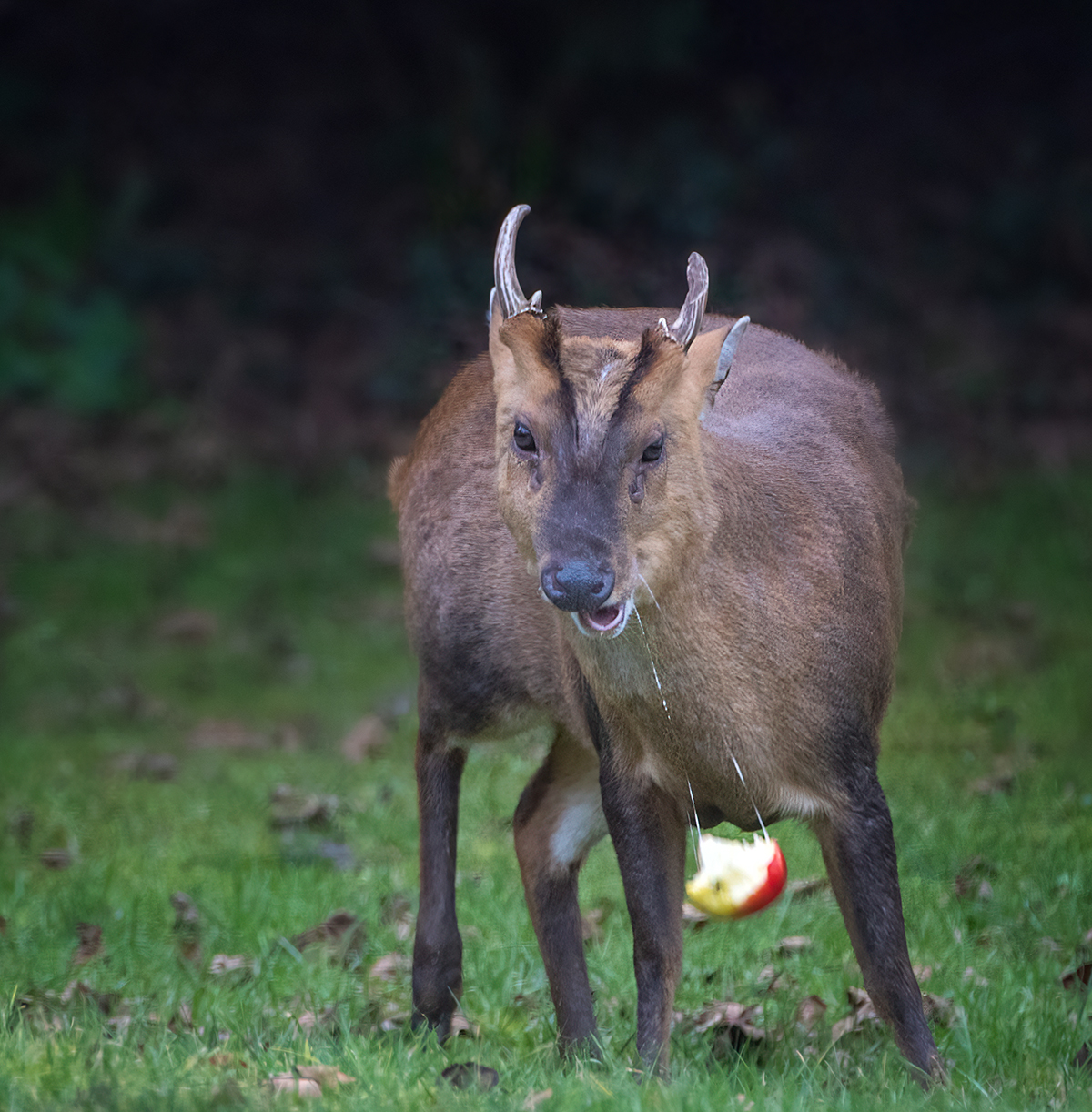
Dina and Selma 🙂 feed the muntjacs with red photogenic apples. The apples are small and hard and the muntjacs first had to learn how to eat such an apple. The male muntjac was not the boss for nothing, it took him a quarter of an hour to eat the first apple, but the next day the apple was gone in no time at all. Fast learning, isn’t it?
Das Folgende liest unsere liebe Nachbarin besser nicht.
Dina und Selma 🙂 füttern die Muntjacks mit kleinen roten Äpfeln. Allerdings mussten die Muntjacks erst einmal lernen, wie sie solch einen Apfel fressen können. Der männliche Muntjack war nicht umsonst der Boss. Den ersten Apfel zu fressen benötigte er eine Viertelstunde, den Apfel am nächsten Tag frass er im Handumdrehen.

.
The muntjac is the arch enemy of gardeners.
Full of anticipation, Siri 🙂 and 🙂 Selma planted masses of bluebells but didn’t realise that bluebells are Haute Cuisine for muntjacs. Our precious classic red tulips suffered the same fate, which made our garden more minimalist.
Der Muntjack ist der Erzfeind der Gärtner.
Voll Vorfreude pflanzten Siri 🙂 und 🙂 Selma Mengen von Glockenblumen nicht wissend, dass Glockenblumen Haute Cuisine für Muntjacks sind. Unseren edlen klassisch roten Tulpen erging es ebenso, was unseren Garten minimalistischer werden ließ.

.
Muntjacs originate from East Asia and, like the Chinese Water Deer, were brought to England by the deer collector Duke of Bedford. We do not know whether any escaped or were released. We see muntjacs every day and hear their barking at night. With this sound, which is not exactly charming to the human ear, the female calls for a mating partner immediately after giving birth. Female muntjacs are constantly pregnant.
Muntjacks stammen aus Ost-Asien und wurden wie das Chinese Water Deer von dem Reh-Sammler Duke of Bedford nach England gebracht. Ob nun welche entkamen oder ausgesetzt wurden, wissen wir nicht. Wir sehen Muntjacks täglich und hören des Nachts ihr Bellen. Mit diesem fürs menschlich Ohr nicht gerade charmanten Ton ruft das weibliche Tier gleich nach der Geburt nach einem Paarungspartner. Weibliche Muntjacks sind ständig schwanger.

.
Maybe you were like us before we came here. We had to google ‘Muntjac’ first. Well, Muntjacs are not as prominent and cute as Bambi, although they belong to the same family.
Vielleicht ging es euch wie uns, bevor wir hierher kamen. Wir mussten ‘Muntjack’ erst einmal googeln. Er ist ja nicht so prominent und süß wie Bambi, obwohl er zur gleichen Familie gehört.
.
What do you do to attract Wild Life to your garden or on your windowsill?
Was erlebt ihr mit Wild Life in eurem Garten oder auf der Fensterbank?
Happy wildlife spotting
Freudiges Naturbeobachten
The Fab Four of Cley
🙂 🙂 🙂 🙂
.
© text and illustrations, Hanne Siebers & Klausbernd Vollmar, Cley next the Sea 2024
 FabFourBlog
There are some Muntjacs in the woodland on Beetley Meadows across the road. But they do not cross the road, or try to get into gardens that are fenced. Some Beetley people complain about them eating things in their garden, and I don’t think anyone feeds them. I doubt they would come into our garden anyway, because Ollie would chase them.
Beautiful photos of the small deer!
Love from Beetley, Pete and Ollie. X
LikeLiked by 4 people
Good morning, dear Pete,
although our garden is fenced off the muntjacs come in through our hedges.
Dogs and Muntjacs is quite a problem. We heard several times that Muntjacs kill dogs or at least hurt them badly when chased.
Thank you for liking Dina’s photos.
With love from the grey sea
The Fab Four of Cley
🙂 🙂 🙂 🙂
LikeLiked by 1 person
If you’re going to be muntjac-friendly, I guess you’ll have to rethink at least some of the flowers. That’s a fair trade though, don’t you think? Maybe that’s easy for me to say half a world away!
LikeLiked by 4 people
You are right, dear Jacqui, we have a kind of flowerless garden. Well, we have many snowdrops and aconites now, lilies later and other flowers muntjacs don’t like.
Have a happy week
The Fab Four of Cley
🙂 🙂 🙂 🙂
LikeLiked by 2 people
Beautiful photos! I’ve never seen this animal before. ❤️😊
LikeLiked by 4 people
Thank you very much, dear John.
Keep well
The Fab Four of Cley
🙂 🙂 🙂 🙂
LikeLiked by 1 person
Like your decision to sacrifice the bluebells and the tulips, I have sacrificed my fruit trees to the birds. We have a lot of birds, especially fruit eating birds, and they eat all the peaches, plums, figs, and blackberries. We tried netting them, but birds got stuck in the netting and it was to upsetting for me so now we just gift them the fruit.
LikeLiked by 5 people
Good morning, dear Roberta,
we sacrifice our figs as well. They blackbirds get them before we do.
Wishing you an easy week and thanks for commenting
The Fab Four of Cley
🙂 🙂 🙂 🙂
LikeLiked by 1 person
My pleasure.
LikeLiked by 2 people
I have to admit, I have no real desire to come back in the next life as a Muntjac, but still… if you’re going to feed me apples?
LikeLiked by 4 people
Dear Jo
we wouldn’t like to be reincarnated as muntjacs. They are too ugly and not liked by most people.
Thanks and cheers
The Fab Four of Cley
🙂 🙂 🙂 🙂
LikeLiked by 1 person
🤗🩵
LikeLiked by 1 person
🙏💫🌟✨🌟💫🙏
LikeLiked by 1 person
They seem to be a lot like our “town deer” who get into every garden that isn’t fenced. I fee sorry for them because they have to eat too, but the unfenced gardens suffer a lot.
LikeLiked by 4 people
Dear Anneli,
our garden is fenced but we have long hedges on two sides and they come through the hedges.
As you say, they have to eat as well. So we don’t mind.
Keep well and thanks
The Fab Four of Cley
🙂 🙂 🙂 🙂
LikeLiked by 2 people
It’s give and take, and often there’s a way to work around the worst of the problems and learn to live with the results.
LikeLiked by 2 people
Liebe Dina und Klausbernd, es freut mich, dass es diese Muntjacs so gut bei euch haben, trotz der Verluste eurer Blumen! Uns fällt auf, dass wir mehr Vögel haben im Garten, vor allem Eichelhäher🦜Vielen Dank für diesen schönen Beitrag!
LikeLiked by 4 people
Guten Morgen, liebe Martina,
Dina ist bei uns die Vogelfreundin; wie Franz von Assisi füttert sie die Vögel, die sie umflattern. Deswegen nennt Selma 🙂 sie auch Franziska.
Schön, dass ihr mehr Vögel im Garten habt. Uns kommt auch der Eichelhäher auch oft besuchen.
Mit lieben Grüßen vom heute grauen Meer
The Fab Four of Cley
🙂 🙂 🙂 🙂
LikeLiked by 2 people
Das klingt ja gut, lieber Klausbernd!🦅🐦⬛🤣
LikeLiked by 2 people
Ist es auch
💙🌻🌼🌸🌼🌻💙
The Fab Four of Cley
🙂 🙂 🙂 🙂
LikeLiked by 1 person
Wirkliche Schönheiten sind es ja nicht gerade, die Muntiaks. Anders die zugewanderten Waschbären, die gerade in unserem Viertel überhand nehmen. Die sind sehr süß, aber nerven nachts mit ihrem Kratzen und Wühlen auf den Etagendächern und Balkonen.
LikeLiked by 4 people
Da hast du wohl recht, wir finden die muntjacs auch hässlich.
Waschbären gibt es bei uns nicht.
Danke fürs Kommentieren, mit herzlichem Gruß vom kleinen Dorf am großen Meer
The Fab Four of Cley
🙂 🙂 🙂 🙂
LikeLiked by 1 person
Lustige und feine Bilder dieser Viecher. Hebeds guet. Ernst
LikeLiked by 4 people
Guten Morgen, lieber Ernst,
schön, dass dir Dina’s Bilder gefallen.
Lass es dir auch gut gehen
The Fab Four of Cley
🙂 🙂 🙂 🙂
LikeLiked by 1 person
I have only heard about Muntjacs here on your page. Somehow the horns look a bit small for an animal of that size and “volume”.
My garden is full of insects, birds and hedgehogs. In summer I put water out for everybody, and in winter food. So, I have residential birds and in winter a lot of visitors for the food. Water and food is the most important for wildlife.
LikeLiked by 4 people
Hi, dear Stella,
we have several places in our garden where we feed all the resident birds and they can drink there as well.
In the late summer we have a lot of dragon flies, during the summer hedge hogs, toads and little field mice.
All the best and thanks for commenting
The Fab Four of Cley
🙂 🙂 🙂 🙂
LikeLiked by 1 person
Fab Four of Cley,
So happy to see a new post. I’ve seen pictures but never knew they were always pregnant or what they ate. Do people hunt them? (I’m not a hunter, but I’m curious how their population is kept in check.
Have a great week!
GP
LikeLiked by 4 people
Good morning, dear GP,
thanks for your comment.
People do hunt muntjacs and some say that their meat is tasty others find it horrible. Although our local butcher sells muntjac meat, we have never eaten it.
Wishing you a wonderful week as well
The Fab Four of Cley
🙂 🙂 🙂 🙂
P.S.
Selma 🙂 just said, now we should taste muntjac-meat.
LikeLiked by 2 people
I think she wants you knowledgeable in ALL things, Klausbernd!
LikeLiked by 2 people
oh dear …
LikeLiked by 2 people
hahaha…
LikeLiked by 1 person
Oh, wie schön! Hm, bleiben sie auch, wenn ihr rausgeht?
Ich hätte Respekt vor ihnen! Aber ebenso wie Dina würde ich knipsen was die Kamera hergibt.
Hier sind die wilden Tiere deutlich kleiner, die Meisen auf dem Balkon. Derzeit eine Übernachtungskohlmeise, die wohl auch wieder hier brüten wird.
Im Sommer habe ich der Balkontür, hinter dem Fliegenvorhang gesessen und ihnen Erdnüsse in einer Dose angeboten. Manche waren mutig, andere flogen schnell wieder davon. Das war schön zu erleben, als die wilden Vögel sich vorsichtig annäherten und schnell eine Nuss stibitzten. 🙂
Liebe Grüße,
Syntaxia
LikeLiked by 4 people
Liebe Syntaxia,
es brauchte eine Weile, bis nicht mehr wegliefen, wenn wir in den Garten kamen. Jetzt haben sie sich jedoch an uns gewöhnt. Wenn wir ihnen nicht zu nahe kommen, gucken sie nur interessiert.
Dina ist auch eine große Vogelfreundin und versucht teils mit und teils ohne Erfolg, die Vögel anzulocken, dass sie ihr aus der Hand picken.
Mit lieben Grüßen vom heute grauen Meer
The Fab Four of Cley
🙂 🙂 🙂 🙂
LikeLiked by 1 person
We have a herd of white-tail deer that come by each day for some carrots. Our neighborhood has learned from day one what to plant that is deer-resistant. We don’t have folks yelling at them since they were here long before the community. Interesting animals.
LikeLiked by 4 people
Dear John,
that sounds great.
Thanks and cheers
The Fab Four of Cley
🙂 🙂 🙂 🙂
LikeLiked by 1 person
Wir hatten nur mal kleine Bergmolche im Garten. Auch die spanische Flagge war mal om Garten. Beide Tiere sind normalerweise nicht ln Wohngegenden.
Wunderbare fotos, by the way, Dina.
LikeLiked by 4 people
Habe herzlichen Dank, lieber Gerhard.
Wir wohnen hier relativ ländlich, deswegen kommen Muntjacks und Rehe in unseren Garten.
Schön, dass dir Dinas Fotos gefallen. Danke fürs Lob.
Alles Gute
The Fab Four of Cley
🙂 🙂 🙂 🙂
LikeLiked by 1 person
Sag mal, lieber Gerhard, was ist denn ‘spanische Flagge’? Wir haben keine Idee, nehmen jedoch an, dass es ein Insekt ist.
LikeLiked by 1 person
Es ist ein Schmetterling 😀
LikeLiked by 1 person
Danke 🙏
LikeLiked by 1 person
Dem sehe ich meist im Wald, auf dem Wasserdost.
LikeLiked by 2 people
I’d never heard of them and although they’re cute, I’d hate to have my flowers used as meals. I sincerely hope your neighbors don’t read this post. 😉
janet
LikeLiked by 4 people
Dear Janet,
we think our neighbours are not looking at social media – hopefully.
It’s a pity that we cannot have tulips, but we can live without.
Keep well and thanks
The Fab Four of Cley
🙂 🙂 🙂 🙂
LikeLike
Ha! Oh the joys!! 😂
LikeLiked by 4 people
Hi John
They love apples.
Thanks and cheers
The Fab Four of Cley
🙂 🙂 🙂 🙂
LikeLiked by 1 person
We fed deer apples when we lived in Oregon, Fab Four. They would come up and eat out of our hands. And bring their babies by for us to meet. And sleep on our porch. We also planted flowers they didn’t like to eat. Lavender was a good example. Peggy would scold them when they came by to eat here roses. But the roses were the thorny type that seemed to thrive on trimming. I confess, I had to google, Muntjac. Fun post. Best not tell your neighbors…
LikeLiked by 4 people
Dear Curt,
we have now lots of different lavenders in our garden (that’s traditional here) and roses. Actually, we like it because it’s less work than having tulips. Muntjacs seem to prefer red flowers. They don’t eat daffodils and yellow tulips. Our muntjacs don’t eat roses.
Thanks and keep well
The Fab Four of Cley
🙂 🙂 🙂 🙂
LikeLike
Sounds like you have it covered. it took us a few years, but we managed to deqrproof most of our yard.
LikeLiked by 2 people
In our garden I have seen coyotes and lots of wild birds at out feeders. There are some wild white tailed deer but they don’t come to our garden they are in the woods nearby. We also hear wolves in the woods at night.
LikeLiked by 4 people
Good morning, dear Anne,
to hear wolves at night is very special. We are not sure but it seems that wolves don’t like the sea that’s because we have hardly any woods here.
Thanks for commenting.
All the best
The Fab Four of Cley
🙂 🙂 🙂 🙂
LikeLiked by 2 people
I see the name muntjac comes from a Malayo-Polynesian language of western Java. That’s one of the places these deer are native to, as you mentioned.
LikeLiked by 4 people
Dear Steve
yes, they originate from quite far away countries. Amazing that they seem to like it here as well.
Thanks
The Fab Four of Cley
🙂 🙂 🙂 🙂
LikeLiked by 1 person
“ . . . which made our garden more minimalist” — I love this! When the deer ate away at your garden, you found something to (humorously) love about the garden in its new form!❤️
LikeLiked by 4 people
Dear Katherine
we are originally Scandinavian and so we like minimalism. Well, we have to arrange ourselves with the wildlife here anyway.
Thanks for commenting and keep well
The Fab Four of Cley
🙂 🙂 🙂 🙂
LikeLiked by 2 people
Die Bilder sind wirklich super. Schön, daß Ihr die Muntjacs in Eurem Garten willkommen heißt.
Liebe Grüße,
Tanja
LikeLiked by 4 people
Guten Morgen, liebe Tanja
herzlichen Dank, dass dir Dinas Bilder gefallen.
Jetzt ist es so, dass wenn die Muntjacs nicht kommen, wir beunruhigt sind.
Liebe Grüße
The Fab Four of Cley
🙂 🙂 🙂 🙂
LikeLiked by 1 person
Re: The screams, I was immediately thinking some four legged wild predator must be killing your deer until I wondered, are their mammal eating predators where you live who aren’t human? Deer don’t show up at The Holler, the coyotes would kill them quickly.
LikeLiked by 4 people
Dear Cindy
the scream comes from a two legged animal – from our neighbour who tries to frighten the muntjacs away.
Muntjacs are hunted. You can buy their meat at our local butcher. But we never had it. The only dangers for the muntjacs are manmade, muntjacs don’t have any predators here.
Thanks and keep well
The Fab Four of Cley
🙂 🙂 🙂 🙂
LikeLike
Love these pictures 🙂
LikeLiked by 4 people
Dear Ritva
thank you.
All the best
The Fab Four of Cley
🙂 🙂 🙂 🙂
LikeLiked by 1 person
Lovely photos, but I wouldn’t be encouraging them in to my garden!
LikeLiked by 4 people
Thanks, dear Jude.
Wishing you all the best and a muntjac-free garden
The Fab Four of Cley
🙂 🙂 🙂 🙂
LikeLiked by 2 people
Ihr Lieben,
herrliche Aufnahmen! Es scheint ihm zu schmecken 🙂
Liebe Grüße
U+H
LikeLiked by 4 people
Liebe Uschi,
nun scheinen Äpfel zu seiner Lieblingsspeise zu werden.
Liebe Grüße auch an Herbert
The Fab Four of Cley
🙂 🙂 🙂 🙂
LikeLike
My dear Fab Four,
Interesting to see what you all attract to your garden apart from pheasants. Absolutely gorgeous photos, Dina-Hanne.
I think the venison we had at yours could have been a muntjac?
I have heard them “barking” when staying at yours.
Kram
Annalena xx
LikeLiked by 5 people
Our dear Annalena,
thanks for your comment.
No, you didn’t have muntjac meat at ours. We don’t eat muntjac – actually, we don’t know why. It isn’t for a reason.
At this time of the year we have lots of pheasants in our garden. We love them and we like to eat them.
With lots of love
The Fab Four of Cley
🙂 🙂 🙂 🙂
LikeLike
Wieder was gelernt und dazu habe ich mich noch köstlich über die Fotos amüsiert! 🙋♀️
LikeLiked by 4 people
Na, das ist doch prima!
Obwohl es hier einige Muntjacks gibt, sind sie doch sonst weitgehend unbekannt. But now you know 🙂
Mit lieben Grüßen vom heute grauen Meer
The Fab Four of Cley
🙂 🙂 🙂 🙂
LikeLiked by 2 people
Dear friends,
I love this post with Dina’s fantastic captures. Did you take them through the window?
I have never seen a muntjac so close before. Do you think this buck is relatively young?
Do you have other visitors with more prominent antlers?
It’s finally warming up a bit up north after the coldest, wildest winter we have had for many years.
Enjoy your wildlife!
Klem Per Magnus xx
LikeLiked by 3 people
Good morning, our dear Per Magnus,
indeed, Dina took the photo through the kitchen window while Selma 🙂 was rolling the apple towards the muntjac. We have absolutely no idea if this buck is young or not. We are total muntjac-greenhorns. We sometimes have deer visiting our garden.
Here, like always, it wasn’t really cold at all. We suppose the coldest was – 5 degrees at night and hardly ever freezing at daytime.
Keep happy and healthy
The Fab Four of Cley
XXXX
🙂 🙂 🙂 🙂
LikeLiked by 1 person
Great photography exemplifies so well these very unique deer.
Thank you friends for sharing exciting photos and story!
LikeLiked by 4 people
Dear Eddie
thanks you soooo much for your kind words.
We are happy that you like our post.
With love to our dear friend
The Fab Four of Cley
🙂 🙂 🙂 🙂
LikeLiked by 2 people
You are so welcome my friends
LikeLiked by 1 person
What a treat to see this series! Love the beautiful details of this creature. He looks happy while enjoying the apple. 🙂
LikeLiked by 3 people
Dear Amy,
we are very sure that he likes the apples. But he only gets one a day.
Thanks for commenting and keep well
The Fab Four of Cley
🙂 🙂 🙂 🙂
LikeLiked by 2 people
💖
LikeLiked by 2 people
Muntjacks waren auch mir bisher nicht bekannt. Da sieht man mal wieder, dass Bloggen doch durchaus bildet 😄 Hier sind es die Rehe, die gern die Gärten plündern. Aber über Äpfel machen sich eher Stare und Amseln her. Seitdem ich die Amseln im Winter immer mit Apfelhälften füttere, bedienen sie sich auch gern schon im Spätsommer an den Äpfeln, die wir eigentlich für uns vorgesehen haben 😂 Muntjacks können ja wohl nicht fliegen, um die Bäume zu beernten, aber wer weiß … 😉 Feine Bilder übrigens von Euren Gartenbesuchern.
Lieben Gruß von der Silberdistel
LikeLiked by 3 people
Liebe Silberdistel,
wir haben viel Fallobst von alten Apfelbäumen in unserem Garten. Wir denken, dass sich die Muntjacks im Herbst darüber hermachen werden. Allerdings wollen wir auch die Zahl der Muntjacks auf unserem Grundstück gering halten. Auch bei uns ist eigentlich das Fallobst für die Stare und Amseln gedacht. Diese roten Äpfel kaufen wir. Sie machen sich im Foto besonders gut.
Vielen Dank für deinen freundlichen Kommentar
The Fab Four of Cley
🙂 🙂 🙂 🙂
LikeLiked by 2 people
They may make good subjects for photography but I would not want them in our garde. I had a beautiful venison pie for lunch in an hotel recently and that puts thought into my mind for the Muntjack!
LikeLiked by 3 people
Dear Paddy,
you are right, we don’t secure our hedge because Dina wants to photograph them.
Well, venison pie sounds yummy. But preparing a shot muntjac turns us off.
Thanks for commenting.
Keep happy
The Fab Four of Cley
🙂 🙂 🙂 🙂
LikeLiked by 1 person
Great photos of this unusual deer! I had to google because I had never heard of them before. Squirrels, rabbits, birds and occasionally skunks are frequent visitors to my back garden. I have a bird feeder. And then the squirrels and rabbits visit for the leftovers on the ground. 🙂
LikeLiked by 3 people
Thank you, dear Mermaid, for your comment. Indeed, muntjacs are unusual dear one doesn’t want to have them in the garden – except you are a photographer.
We have lots of squirrels too and many different birds. Cley next the Sea is called ‘Mecca of Birdwatching’ in the UK.
All the best
The Fab Four of Cley
🙂 🙂 🙂 🙂
LikeLiked by 1 person
The apples really do create great photography.
LikeLiked by 2 people
Dear Jenny,
Dina has chosen these small red apples as they are photogenic.
Thanks. Keep well
The Fab Four of Cley
🙂 🙂 🙂 🙂
LikeLiked by 2 people
Yes they are!
LikeLiked by 2 people
The muntjacs with the apples look amazing.
Wonderful photos!
LikeLiked by 3 people
Thanks a lot, dear Rabirius 🙏🙏
We wish a happy day
The Fab Four of Cley
🙂 🙂 🙂 🙂
LikeLiked by 1 person
Best of luck with the muntjacs. We have the regular deer here. During lean winter times, the trees are all “pruned” to a consistent height by their nibbling.
LikeLiked by 3 people
Dear Brad
thanks for commenting.
After these pictures were taken, we tried to keep them away from our garden. At ours they ‘pruned’ our hedges.
Keep well
The Fab Four of Cley
🙂 🙂 🙂 🙂
LikeLiked by 1 person
We’ll have to keep an eye out for them on our next visit to Merry Olde England.
LikeLiked by 2 people
Good luck spotting them.
LikeLiked by 2 people
The word ‘muntjac’ is nearly as interesting as the animal. An etymological search revealed that the word first was recorded in 1790–1800; it came via the Dutch and the Sundanese mənyčək, meaning “a kind of chevrotain.” I found examples of their barking online, and was surprised how closely it does resemble a dog’s bark. I wondered about their puffy eyes, but I see that they have large glands beneath their eyes: perhaps scent glands. The striped horn on the male is quite attractive. It looks as though this one has seen a bit of combat.
The apple’s a perfect touch: not only the color, but also the action it evoked. It reminded me of the first time I fed an apple to a horse. I held the apple, while the creature took four perfectly spaced bites as I turned it, then finished off the core. Great fun! Today, my only creatures are an abundance of birds and squirrels, but I do have one squirrel that will take nuts from my hand.
LikeLiked by 3 people
Good morning, dear Linda,
thank you so much for all the information. We hear them barking quite often mostly at night. We didn’t know about the glands beneath their eyes.
We haven’t seen muntjacs with bigger horns than this one Dina photographed.
Now we keep them away from our garden.
Keep well
The Fab Four of Cley
🙂 🙂 🙂 🙂
LikeLiked by 2 people
I have never heart of those animals but it is wonderful they are coming and you can see them so close enjoying the apple. Interesting to learn about them.
I have Squirrels in my garden and of course lots of burried nuts. 🙂 My little Robin comes often and more in the evening we have the urban foxes roaming through.
The frogs love our pond. I also have seen Jays. Let’s see waht this year brings, may be more animals!
LikeLiked by 3 people
Thank you very much, dear Ute.
The muntjac didn’t come that near. Selma rolled an apple toward him and Dina photographed with a long lens.
We have Jays, Robins and Squirrels as well. Actually, the Squirrels are a pest. They dig holes in our lawn and eat all the bird food but they are funny.
Happy wildlife spotting
The Fab Four of Cley
🙂 🙂 🙂 🙂
LikeLiked by 2 people
I admire Dina’s willingness to study these not-beautiful creatures closely. We have a relative, the Black-tailed deer, that often meanders through the yard here, picking and choosing little tidbits. I get upset when that includes a plant I care about but they rarely take large amounts of any single plant. They do eat the apples they can reach on our apple trees, which is OK. It’s probably good to be reminded regularly that we are not really in control! 🙂
LikeLiked by 3 people
Dear Lynn,
we are never 100% in control, that’s one way to see it.
The problem with muntjacs is that they are greedy. It seems to us the eat everything they can get.
Wishing you a happy weekend
The Fab Four of Cley
🙂 🙂 🙂 🙂
LikeLiked by 2 people
Excellent captures of these muntjacs and their apples – I can almost hear them munching! Thank you for telling their story, and also for tolerating them eating your flowers. Sometimes we have dear coming into our garden, but that is not often. We even had a moose several years ago. Stay well!
LikeLiked by 3 people
Dear Ann-Christine,
thanks for commenting.
I don’t like the muntjacs in our garden but behind my back Selma 🙂 is feeding them. Well, I am the gardener …
A moose in the garden that’s really something. When I saw my first moose I was shocked how big they are.
Wishing you a relaxed weekend
The Fab Four of Cley
🙂 🙂 🙂 🙂
LikeLiked by 1 person
Wishing you the same! And yes – they are big…mooses. We don’t want to meet them while we are driving a car.
LikeLiked by 2 people
Guten Morgen Ihr Vier!
Sie mögen nicht aussehen wie Bambi, aber ich finde sie trotzdem sehr coole Tierchen.
Hier in unserem Garten sehen wir leider nicht viel Wild Life. Zwar legen wir hier nach und nach einen Garten für Wildvögel und Co an, aber wir sind umzingelt von Menschen, die in ihrem Garten nur Beton und Pools stehen haben und meinen, der Himberstrauch und die F1-Hybride ihrer Tomate seien der große Wurf in Sachen Garten.
Immerhin hatte sich in letzten Jahr ein Igelpärchen hierher verirrt und wir haben nun ein Igelhaus aufgestellt.
Habt ein wunderschönes Wochenende!
Barbara
LikeLiked by 3 people
Liebe Barbara,
das ist hier völlig anders. Die meisten Leute zogen aus der Großstadt hierher, um in und mit der Natur zu leben – teilweise naiv, aber immerhin. Es ist in, seinen Garten wildlife-friendly zu gestalten. Dazu kommt, dass hier die meisten Grundstücke größer sind, als es in Deutschland üblich ist. Wir haben für hiesige Verhältnisse einen eher kleinen Garten mit 5000 qm hinten und 1500 qm vorne. Da haben wir natürlich auch einige unkultivierte Ecken, die Wildlife anziehen.
Igel haben wir auch in unseren Hecken. Ein Igelhaus, das hört sich toll an. Selma 🙂 hat sogleich angefangen, Holz für ein Igelhaus in unserem Schuppen zu suchen.
Auch dir ein wunderschönes Wochenende. Wir haben gerade unseren Gesundheitsmonat mit wenig essen, kein Alkohol trinken und lange am Meer entlang spazieren gehen und Strandgut sammeln. Das bekommt uns gut.
Liebe Grüße
The Fab Four of Cley
🙂 🙂 🙂 🙂
LikeLiked by 2 people
Goodness, those are unusual neighbours, combining cuteness with a high nuisance factor. Very photogenic though!
LikeLiked by 4 people
Thank you very much, dear Margaret 🙏🙏
Wishing you a relaxing weekend
The Fab Four of Cley
🙂 🙂 🙂 🙂
LikeLiked by 2 people
Thank you. You too!
LikeLiked by 2 people
Pingback: Wildlife in the garden – Gazee Press Words