Some time ago, we visited a well-known photographer. Siri and Selma were immediately attracted to his large library, which they looked at a little shyly, not knowing whether it was appropriate or not. They were completely amazed when they saw that it contained only photo books. They had no idea that there were so many photo books and thought we already had a lot of books about photography, after all, a huge shelf full of them in our library. Over tea, they asked the friendly photographer: “If you could recommend just one book to us, what would it be?” Without hesitation, he took the bright yellow book by Joel Meyerowitz, ‘Seeing Things’ off the shelf.
Vor einiger Zeit besuchten wir einen bekannten Fotografen. Siri und Selma fühlten sich sofort von seiner großen Bibliothek angezogen, die sie etwas schüchtern betrachteten, weil sie nicht wussten, ob sich so etwas gehört. Sie waren völlig verblüfft, als sie sahen, dass es dort nur Fotobücher gab. Sie wussten gar nicht, dass es so viele Fotobücher gibt und dachten, wir hätten schon viele Bücher über Fotografie, immerhin ein riesiges Regal voll in unserer Bibliothek. Beim Tee fragten sie den freundlichen Fotografen: “Wenn Sie uns nur ein Buch empfehlen könnten, welches wäre das“? Ohne zu zögern zog er das leuchtend gelbe Buch von Joel Meyerowitz ‘Seeing Things‘ aus dem Regal.
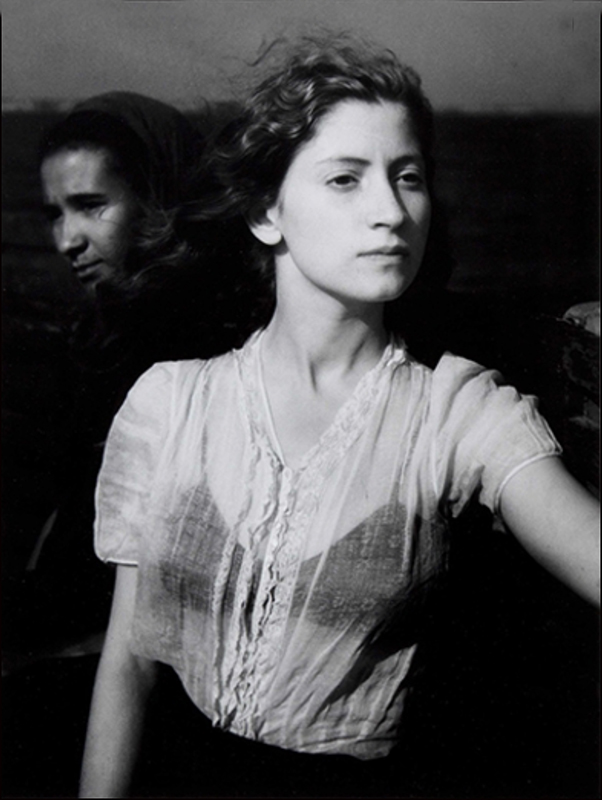
Under the category heading “Looking Into the Future,” the 1947 photograph by Édouard Boubat captures a young girl, Lella, traveling through the French countryside in the back of a truck. “We don’t know what she is looking at or where she is going. But it doesn’t matter, because this picture is about Lella looking forward into the future… Her gaze becomes a symbol, a metaphor for change and the ongoing passage of time. Every second we experience disappears as we live it. Right now is slipping away into the past as you move forward. But a photograph stops time and preserves fleeting beauty, such as Lella’s, lifting it into something meaningful beyond the moment, into something timeless.”
It is actually a book that aims to show children how to look at photographs in a meaningful way. There is always a page of a photo next to a page of clever text. Dina and Klausbernd also found this immediately stimulating. What we see determines how our environment speaks to us. If we take a closer and more critical look, it’s like an awakening. Klausbernd and Dina have always regretted that critical vision is not taught at school, even though our communication is increasingly shifting from words to images thanks to the internet.
Eigentlich ist es ein Buch, das Kindern zeigen will, wie man Fotografien sinnvoll betrachtet. Eine Seite mit Fotos steht stets neben einer Seite mit klugem Text. Auch Dina und Klausbernd fanden das sofort anregend. Was wir sehen, bestimmt, wie unsere Umwelt zu uns spricht. Wenn wir genauer und auch kritischer hinsehen, ist das wie ein Erwachen. Klausbernd und Dina haben immer bedauert, dass kritisches Sehen in der Schule nicht gelehrt wird, obwohl sich unsere Kommunikation durch das Internet zunehmend vom Wort zum Bild verlagert.
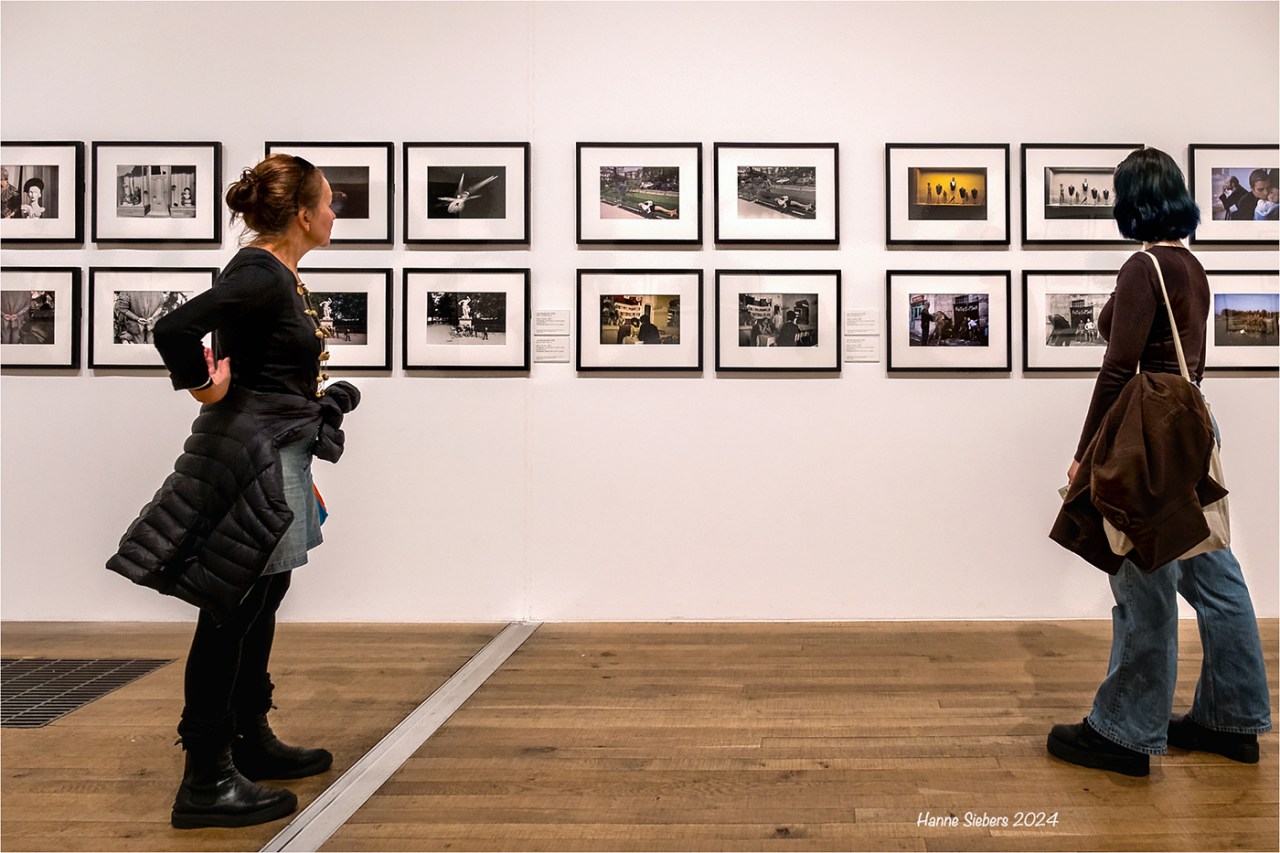
When we visited the Tate Modern a few days ago, we were amazed to see an entire room dedicated to the photographic works of Meyerowitz. We looked for Rothko and found Meyerowitz. Rothko’s pictures were on loan to Tate St Ives in Cornwall, so we had to make do with a Rothko calendar. Rothko’s paintings, says Klausbernd, have to be seen in the original to discover their complexity. If Meyerowitz writes that a photograph can be like a poem, then the same can be said of Rothko’s pictures. As in photography, light is essential in Rothko’s work, the filtering of light through the many layers of colour.
Als wir vor ein paar Tagen die Tate Modern besuchten, waren wir erstaunt, dass ein ganzer Raum den fotografischen Arbeiten von Meyerowitz gewidmet war. Wir suchten Rothko und fanden Meyerowitz. Rothkos Bilder waren an Tate St Ives in Cornwall ausgeliehen, also mussten wir uns mit einem Rothko-Kalender begnügen. Rothkos Bilder, sagt Klausbernd, müsse man im Original sehen, um ihre Vielschichtigkeit zu entdecken. Wenn Meyerowitz schreibt, dass ein Foto wie ein Gedicht sein kann, dann kann man das ebenfalls von Rothkos Bildern sagen. Wie in der Fotografie ist auch bei Rothko das Licht wesentlich, die Filterung des Lichts durch die vielen Farbschichten.
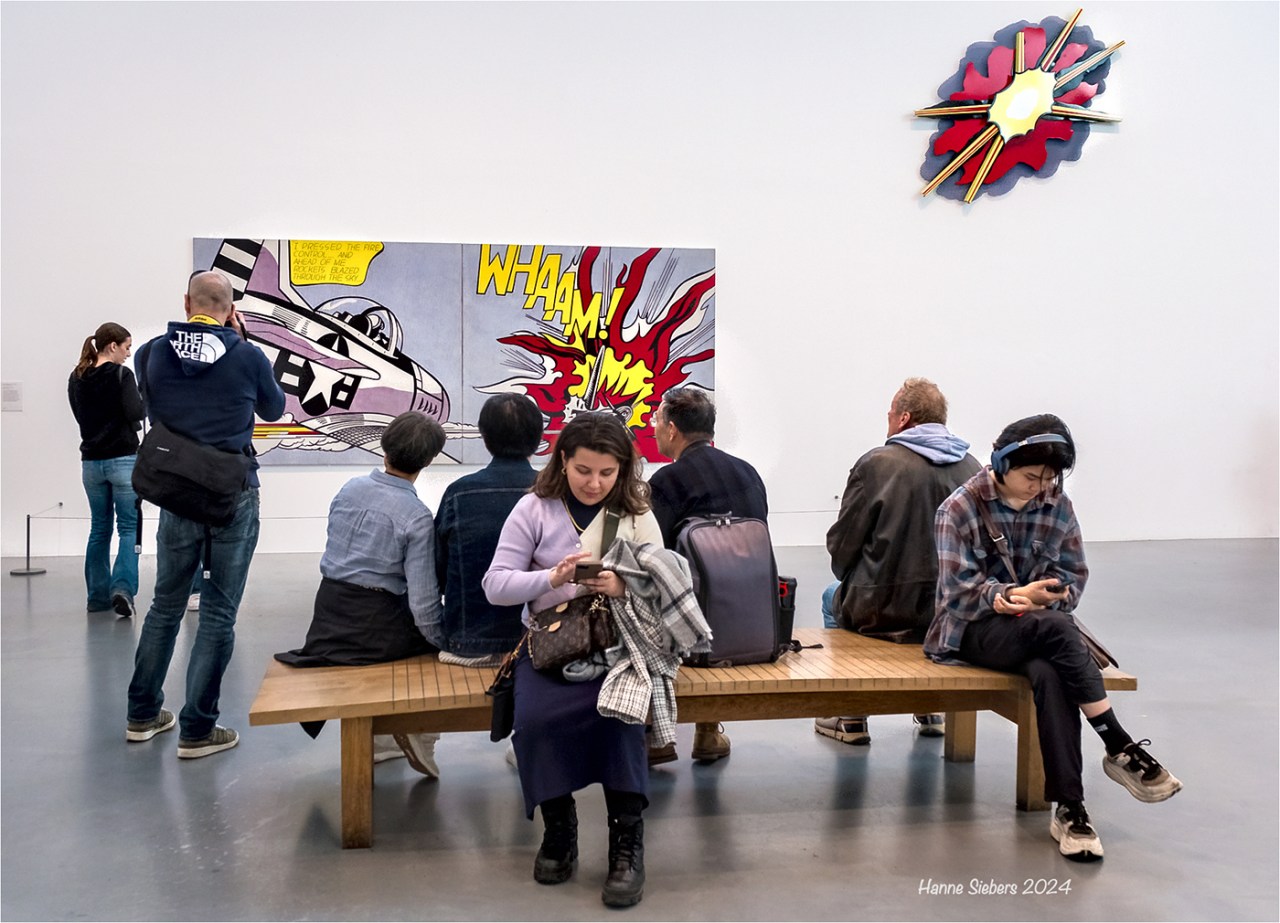
In a painted or photographed modern picture, we often do not know what is being depicted or meant, at least not at first glance, like when we see “Wham!” f.e. To find out, we are forced to pause and take a closer look. This precise and analytical way of seeing is particularly important in the context of AI, as we often do not immediately recognise whether something is an image of reality or an artefact. Photography makes time stand still and also makes us as viewers stand still if it is not an image that we have seen many times before. As in the visual arts, alienation in photography also promotes realisation. We take a closer look, and it is this closer look that Meyerowitz wants to teach us in his gracefully designed book.
Bei einem gemalten oder fotografierten modernen Bild wissen wir zumindest auf den ersten Blick nicht, was dargestellt ist oder was es bedeutet wie z.B. bei “Wham!”. Um das herauszufinden, sind wir gezwungen, innezuhalten und genauer hinzusehen. Dieses genaue und analytische Sehen ist gerade im Zusammenhang mit KI wichtig, da wir oft nicht sofort erkennen, ob etwas ein Abbild der Realität oder ein Artefakt ist. Die Fotografie lässt die Zeit stillstehen und uns als Betrachter auch, wenn es sich nicht um ein Bild handelt, das wir so oder ähnlich schon oft gesehen haben. Wie in der bildenden Kunst fördert auch in der Fotografie die Verfremdung die Erkenntnis. Wir schauen genauer hin, und dieses genauere Hinsehen will uns Meyerowitz in seinem anmutig gestalteten Buch lehren.
Happy seeing
Frohes Schauen
The Fab Four of Cley
🙂 🙂 🙂 🙂
Lit.:
Meyerowitz, Joel: “Seeing Things” (aperture, New York 2016)
© text and illustrations, Hanne Siebers & Klausbernd Vollmar, Cley next the Sea 2024
 FabFourBlog
Thanks for the book recommendation, the informative text, and the lovely accompanying photos.
Love from Beetley, Pete. X
LikeLiked by 4 people
You are very welcome, dear Pete
We wish you a cosy evening
The Fab Four of Cley
🙂 🙂 🙂 🙂
LikeLiked by 1 person
Thank you for giving us time to reflect on the meaning of photography and to respond to the fascinating examples the great photographers in our modern world. Warm greetings from Canada to the FabFour!
LikeLiked by 4 people
Thank you very much for your kind words, dear Peter.
With warm greetings back from Merry Old England
The Fab Four of Cley
🙂 🙂 🙂 🙂
LikeLiked by 2 people
Fab Four of Cley,
I have always felt that photographers stop time for us to see what they see. They find some many things that we just pass by.
GP 😮
LikeLiked by 5 people
Dear GP
We agree with you.
Funnily enough, we noticed a paradox: On an expedition to the Arctic with lay people and scientists, at the end of the journey quite some of the lay people said that they would like to do this journey again without the stress of having to photograph all the time but seeing in a relaxed way. The photographers made us often see more but they saw less because they were always busy with their equipment and finding interesting perspectives.
Thanks for commenting.
Keep well and cool
The Fab Four of Cley
🙂 🙂 🙂 🙂
LikeLiked by 4 people
Ah, good point. That’s something to think about!
LikeLiked by 3 people
I will have to look for this book to add to my collection also! Fab photos by Hanne as always 🙂
LikeLiked by 4 people
Dear Fraggle
we are sure you’ll like this book. The combination of pictures and text is really clever.
Thanks for liking Hanne-Dina’s photos.
A happy week wishing you
The Fab Four of Cley
🙂 🙂 🙂 🙂
LikeLiked by 2 people
I have always loved photographs and think this text by Hanne and klausbernd comes closest to explaining why. Thank you.
LikeLiked by 4 people
Thank you VERY much, dear John.
The Fab Four of Cley
🙂 🙂 🙂 🙂
LikeLiked by 1 person
😁
LikeLiked by 2 people
Thank you for such an interesting and informative article and the beautiful accompanying photos.🤍
You have helped me reflect on the true meaning of photography
LikeLiked by 4 people
Dear Luisa
we were inspired to produce this post with its text and pictures by Meyerowitz’s book. It enhanced our creativity and what more can you expect of an art book. We think it’s important to reflect how we see if we want to take photos worth to look at.
Thanks for commenting
The Fab Four of Cley
🙂 🙂 🙂 🙂
LikeLiked by 1 person
I am the one who thanks you for this wonderful reply and for the fascinating post you shared. 🙏💙🙏
LikeLiked by 3 people
I did see the Rothko paintings at Tate St Ives, but I wasn’t impressed. They are in a dark room, which may be exactly what he intended, but which made it difficult to study them closely. After coming from the very bright exhibition of Beatriz Milhazes it was a huge contrast.
LikeLiked by 4 people
What a shame, dear Jude. Klausbernd saw these pictures in a dark room, but with strong spotlights on each of them. As a result, he could see the different layers of colour, making them appear dynamic.
Hanne-Dina and Selma are fans of Rothko. Klausbernd prefers Roy Lichtenstein and Siri hasn’t decided yet.
Thanks and warm greetings from Norfolk
The Fab Four of Cley
🙂 🙂 🙂 🙂
LikeLiked by 1 person
Lieber Klausbernd und team, ich habe den Rundgung im Tate Modern Museum zusammen mit euch sehr genossen und denke auch, dass wir uns viel mehr Zeit nehmen sollten, um zu überlegen, was der Künstler uns möglicherweise mitteilen will und ob das Kunstwerk echt sein könnte! Das Letzere ist aber wahrscheinlich nicht so einfach! Grazie mille
LikeLiked by 4 people
Liebe Martina
Kunstbetrachtung benötigt Zeit, das hast du recht.
Die Frage, ob ein Kunstwerk mit KI oder nicht erstellt wurde, kann möglicher Weise interessant sein, finden wir aber nicht so wichtig. Es kommt, wie es uns scheint, darauf an, ob das Kunstwerk funktioniert, d.h. ob es wirkt und den Betrachter in welche Weise auch immer anspricht. Mit welchen Produktionsmitteln die Kunst erzeugt wurde, scheint mir zweit- wenn nicht drittranging zu sein.
Du kannst dazu auch in David Hockneys Buch “Secret Knowledge” schauen, um zu sehen, welche raffinierte Hilfsmittel Maler spätestens seit dem 17. Jh. nutzten.
KI in gekonnter Weise zu nutzen, setzt so viel Können voraus wie den Pinsel gekonnt zu führen.
Habe herzlichen Dank für deinen Kommentar
The Fab Four of Cley
🙂 🙂 🙂 🙂
LikeLike
Lieber Klausbernd, hab vielen Dank für deine Erklärungen bezüchlich mit
KI hergestellten Kunstwerken und du hast natürlich recht, Hauptsache wir
empfinden etwas!
Du machst mich ganz neugierig, was die Hilfsmittel früherer Maler betrifft.👏
LikeLiked by 4 people
Meist optische Hilfsmittel ähnlich einer Kamera Obscura und Kombinationstechniken.
LikeLike
👍🌻
LikeLike
💙💫✨🌟✨💫💜
LikeLike
Thanks for the tour of photography and how it helps us to really see things.
LikeLiked by 3 people
You are very welcome.
Wishing you an easy rest of the week
The Fab Four of Cley
🙂 🙂 🙂 🙂
LikeLiked by 1 person
Thanks. 🙂
LikeLiked by 1 person
It’s a funny dynamic- seeing, and seeing through a camera. Sometimes, out walking, I like to just look and embrace what I’m seeing, but if I don’t have a camera with me I’m bound to want to capture an image. It would be interesting to take a critical vision class. Thanks for seeing things for me, Klaus.
LikeLiked by 5 people
Dear Jo
There is a question closely related to how a photographer sees things. It’s why the photographer wants to take that particular picture. The big disadvantage of digital photography is that’s too easy to take a photograph and therefore everybody photographs everything. Therefore it isn’t worth looking at most of the pictures because they are all alike. That doesn’t mean that there are pictures worth looking at. But these are usually pictures the onlookers need some time and thinking to understand them. ‘Good’ pictures change our perception.
In the end, the question is what is worth photographing – but that would be a topic for another post.
Thanks for commenting
The Fab Four of Cley
🙂 🙂 🙂 🙂
LikeLiked by 1 person
A fascinating post! The words of Meyerowitz along with Boubat’s photograph should be broadcast around every school of the visual arts. Thank you for this eye opening post! I might just have to find a copy of Mayerowitz’s book! 😊
LikeLiked by 4 people
Thank you very much, dear Ashley.
Good luck finding Meyerowitz’s book. We are sure you’ll love it.
All the best
The Fab Four of Cley
🙂 🙂 🙂 🙂
LikeLiked by 1 person
I’ve just ordered it (used). Again, thank you for the recommendation. 🙋♂️
LikeLiked by 3 people
Happy looking at the photos and reading
The Fab Four of Cley
🙂 🙂 🙂 🙂
LikeLiked by 1 person
Hello Fab Four! The book arrived, ordered from a used book website, but it’s brand new, still in its cellophane wrap! Thank you for the suggestion as it is brilliant and NOT JUST FOR KIDS! Every page is amazing but there is one photo that I especially love: Garry Winogrand’s ‘Frieze’! Love it. The Eugene Atget ‘Past and Present’ reminds me of pictures and photos I would see in ‘The London Illustrated News’. I don’t think it exists now although there might be an archive of it somewhere. Have a great winter! 🙏
LikeLiked by 1 person
GREAT! We are so happy that you like it as well.
The Fab Four of Cley
🙂 🙂 🙂 🙂
LikeLike
We LOVE this book and can highly recommend it. It’s an inspiration for all photographers, not just kids and fayries and it connects you with the images in a way we have never experienced before.
The pictures Meyerowitz are presenting are less uni-vocal and require slower readings and slower readers. In this context, perhaps Meyerowitz’s formalism is, in part, a tool to help us slow down.
Still contemplating,
Siri & Selma 🧚🏻♀️📷🧚🏻
LikeLiked by 4 people
Dearest Siri & Selma
Thank you very much for commenting. You are one of the few commenting here who have looked at and read this book.
As Dina and Klausbernd you were fascinated by “Seeing Things”. Isn’t that recommendation enough?
And it even made you speedy Fayries slow down.
With lots of love
Hanne-Dina & Klausbernd
LikeLike
Eine tolle Empfehlung, ihr Lieben, vielen Dank dafür!
LG U+H
LikeLiked by 3 people
Liebe Uschi, lieber Herbert
viel Spaß beim Lesen und Gucken.
Mit ganz lieben Grüßen von der herbstlichen Küste
The Fab Four of Cley
🙂 🙂 🙂 🙂
LikeLike
Dear friends,
This book is like a revelation and new to me and certainly something I’ll look into. Thank you! Love the photo of Lella, so evocative.
I went to a museum with some Rothko painting this summer. Then I read this:
People know Rothko. They know that name. They’ve seen a work in every museum. And in every museum they feel nothing. They cannot explain, truly, why Rothko is great. I know this because not one person in two hours stood for more than thirty seconds in front of a work and you need at least 15 minutes … with a guide line how to position yourself, where to look …Didn’t quite work for me.
Kram Annalena x
LikeLiked by 3 people
Dear Annalena
You are right. At the first glance, a Rotho picture is not that different to pictures of the Bauhaus painter Josef Albers (which I like very much). You need some time and good light to see or guess the different layers of colour behind the colour you see at first. Rothko is more ‘painterly’ than Albers f.e. with the boundaries of the rectangular colour fields which not a clear line. I personally prefer the clarity of Albers.
Many years ago I visited with a painter the Tate Modern where Rothko had his own room. There was a bench for meditating on one of Rothko’s pictures. Four people could sit there at the same time and this place was always taken. People fell into a kind of meditative trance looking at Rothko’s picture.
Thank you, my dear friend
KRAM
Klausbernd 🙂
LikeLiked by 1 person
I shall have to seek out this book, it sounds fascinating. Like restlessjo commented, I tend to spot something and want to capture it in the best way that I can. If you look too long, you may miss the moment and perhaps over-think or over-complicate things! 🤔
LikeLiked by 4 people
Dear Mike
We are sure you will love this book not only because of the pictures and their explanation but also because the text is nicely set.
The basic question for the photographer is, why do you want to hold that moment? And what do you want to communicate with that picture?
Thanks and keep well
The Fab Four of Cley
🙂 🙂 🙂 🙂
LikeLiked by 1 person
Thanks for sharing that, I love Joel’s photography. I’ll look up “Seeing Things “ for sure. Have a wonderful day!
LikeLiked by 3 people
We love it too. We didn’t know that it was him to make colour photography respected as art.
Thanks
The Fab Four of Cley
🙂 🙂 🙂 🙂
LikeLiked by 1 person
Ich hatte ja in meinen “Tagesgedanken” einen ähnlichen Punkt angesprochen.
Ich war am Samstag in einer Gustav Metzler-Ausstellung in Frankfurt gewesen. Bei einer nachträglichen Führung wurde auch das Bild “Selbstbildnis eines Unbefleckten” aus seinen Anfängen betrachtet. Mir fiel gleich die besondere linke Hand auf, die dem Führenden so zum ersten Mal auffiel. Alle schauten wohl auf das schmerzverzerrte Gesicht des Dargestellten. Aber nicht weniger bedeutsam war die offene Hand, die ausgestreckt zur Erde, an den Körper angelehnt war. Ich dachte sogleich an eine ikonographische Bedeutung, aber niemand schien sie zu kennen. KI sagte mir zuhause, daß es da keine eindeutige Auslegung dieser Haltung in der Kunstgeschichte gibt.
Wie dem auch sei: Sehen ist etwas Erworbenes, etwas Trainiertes, etwas Gewolltes.
So könnte man es formulieren.
LikeLiked by 2 people
Lieber Gerhard
in der Tat, Sehen und mehr noch Bewertung des Gesehenen ist ein gelerntes Verhalten. Oliver Sacks hat sich damit viel beschäftigt.
Es ist bei jeder Wahrnehmung so, wie mir scheint, schauen wir nur kurz hin, sehen wir erschreckend konventionell. Um daraus auszubrechen müssen wir länger hinschauen. Kurz geschaut triggert die Emotionen, die meist äußerst konventionell sind, länger geschaut schaltet sich der Intellekt ein, der die Konventionen überkommen kann. Um zu richtig zu sehen benötigt man Abstand, auch Abstand von seinen spontanen Reaktionen.
Danke, dass du einen neuen Aspekt in die Auseinandersetzung ums Sehen hier hereingebracht hast
The Fab Four of Cley
🙂 🙂 🙂 🙂
LikeLiked by 1 person
“Sehen … ist ein gelerntes Verhalten. ”
Auch der Neurophilosoph Georg Northoff untersucht(e) das Sehen. Er brachte in seinem Buch ein Beispiel: Ein Kloster in einem Wald eines Berghangs. Der Europäer bemerkt das Kloster, der (Ost?!)-Asiate den Wald des Berghangs.
LikeLiked by 3 people
Man sieht nur, worauf sein Interesse ausgerichtet ist. So sieht der Hungrige nur Bäckereien und der Buchfreund nur Buchhandlungen in der Stadt 🙂
LikeLiked by 1 person
Nice post 🌺🌺
LikeLiked by 3 people
Thank you
The Fab Four of Cley
🙂 🙂 🙂 🙂
LikeLike
An excellent point about teaching critical vision
LikeLiked by 3 people
Thank you, dear Derrick
As a teacher you know how important that would be and on the other hand how little that is discussed in schools. If we don’t teach how to see things, we are easy prey for fake news and other manipulation on the net.
We wish you a happy rest of the week
The Fab Four of Cley
🙂 🙂 🙂 🙂
LikeLiked by 1 person
I have had chats over the past while on what is the best approach to photographing a garden – my photography is largely confined to gardens, garden plants and wild flowers. Some see the garden as a place where one may create beautful images or flowers, trees, flowerbeds and the likes but often without producing images which give the viewer any overall impression of the garden. This style of image is used extensively to illustrate magazines and books and, while very pleasant and appealing, I find it little more than “eye candy”, attractive but not informative and, without the context of the garden, somewhat meaningless. I like to see some general views, some overall impressions of the garden to provide setting for the vignettes one may encounter there. Generally, I think photography is an excellent educational tool for childen. It encourages one to look, something we seldom do. As ever, I have enjoyed your post very much. Many thanks.
LikeLiked by 4 people
Dear Paddy
Thanks a lot for your detailed comment. We really much like it.
Understanding a picture means presenting it in a wider context, we agree. These pictures that we have seen many times we don’t see anymore. We just recognise them and that’s it. To make people see we need a certain kind of alienation or we say ‘without alienation there is automatisation’ and automatisation is the killer of understanding.
Another way is combining pictures with text what many contemporary artists do and what we do when blogging.
We love your expression ‘eye candy’ – GREAT👍 👍
Thanks again
The Fab Four of Cley
🙂 🙂 🙂 🙂
LikeLiked by 1 person
Boubat’s Lella has become one of the most recognised and memorable portraits of idealised beauty in classic photography. “It is a portrait of beauty, innocence, youth and purity, adjectives that also describe the spirit of Boubat’s photography.”
Like Joel Meyerowitz, I was so captivated by this portrait that I returned to my library of photo books to learn more about Boubat. This is a portrait of devotion for the photographer. “Lella would eventually become Boubat’s first wife and a continuous muse throughout his life. It is in the personal relationship between the photographer and model where a sense of magnetism and intimacy is possible; only through the wondrous gaze of a young lover could Boubat have achieved pictures that stir the heart.” A loving eye certainly helps, but I’m not convinced he captured the magic solely because he was in love. I’m looking forward to dive into his work. It’s not easy to find books in English about Boubat and his muse..
LikeLiked by 3 people
Our dearest Dina
We wish you good luck finding books from and about Boubat.
You need much more than a loving eye to be able to take such an epic photograph.
Thank you for telling us about the relationship between Boubat and Lella, we didn’t know.
With lots of love ❤ ❤ ❤ xxx
Siri, Selma and Klausbernd
LikeLiked by 1 person
Thanks for the suggestion regarding a photography book. I have many books at home, but there can never be too many, especially as photography, much like any art form, thrives on continuous learning and inspiration. I find that books are always my best resource. And what better way to learn than from the experts themselves through books? Thanks for sharing, and have a good day 🙂 Aiva xx
LikeLiked by 4 people
Dear Aiva
we have a lot of books about photography and showing photographs for learning and inspiration. Siri & Kb are mostly interested in the theory of photography like Roland Barthes and Hockney & Gayford, Selma & Dina are interested in looking at the works of famous photographers for inspiration. We all like very much Hockney’s and Gayford’s book about the history of pictures. But Meyerowitz book has a special charm we immediately fell for.
Thanks for commenting
The Fab Four of Cley
🙂 🙂 🙂 🙂
LikeLike
1000 Dank für die Buchempfehlung und herzliche Grüße! 🙂
LikeLiked by 3 people
Da nicht für, liebe Maren.
Herzliche Grüße zur schönsten Stadt Deutschlands
The Fab Four of Cley
🙂 🙂 🙂 🙂
LikeLiked by 1 person
This is a world I know so little about. I clicked through to Joel’s book. What a cover! And I love the gallery comparison of a photo displayed two different ways. Excellent post.
LikeLiked by 3 people
Thanks a lot, liebe Jacqui
Kb. is interested in perception. He got his degree in Psychology for his studies in perception and learning. And, of course, Dina as a photographer is a specialist concerning perception as well. So we talk a lot about how we see things with Siri and Selma and notice the different perceptions of our generation and the next.
We are happy that you like our post
The Fab Four of Cley
🙂 🙂 🙂 🙂
LikeLiked by 2 people
That 1947 photograph by Édouard Boubat is absolutely stunning. It is hard to look away from!
LikeLiked by 4 people
Thank you very much for your comment 🙏 🙏
Indeed, we love his photography as well although Siri and Kb. prefer abstract and B&W photography
All the best
The Fab Four of Cley
🙂 🙂 🙂 🙂
LikeLike
I’m intrigued by this book now. I’ll have to give it a whirl, especially when my little one gets a bit older. Thanks for sharing. Cheers. Linda
LikeLiked by 3 people
Thank you, dear Linda 🙏 🙏
The Fab Four of Cley
🙂 🙂 🙂 🙂
LikeLiked by 1 person
I understand (as both a photographer and a teacher) your wish that schools would teach children about critical vision. However, because American schools are failing to teach a large number of students to read, write, and do arithmetic, I submit that those failings have to be remedied first, along with history, geography, and civics.
LikeLiked by 3 people
I agree with you. We live in surroundings where reading, writing and arithmetics are well taught to all the children as well as history and geography and at least one foreign language. These are the basics, no doubt. To teach about critical vision comes secondary.
Thanks
The Fab Four of Cley
🙂 🙂 🙂 🙂
LikeLiked by 1 person
Wonderful photos and inspirational art❣️
LikeLiked by 2 people
Thank you very much, dear Val.
Wishing you a happy day
The Fab Four of Cley
🙂 🙂 🙂 🙂
LikeLike
A quote we just found
“my destination is no longer a place, but rather a new way of seeing”
Marcel Proust.
Proust makes his readers see the world in a new way.
LikeLiked by 2 people
Sounds very good, Klausbernd.
Do you have any travel plans for next month?
LikeLiked by 1 person
Dear Per Magnus
Yes, we do. We want to go south to Hampshire; the rest is a secret for my birthday. Hanne-Dina, Siri, and Selma are secretly downloading maps and consulting our travel books about southern England. I am really looking forward to our little trip down south.
Are you staying in Longyearbyen until the new year?
Concerning this quote, well, like it is with many quotes, some think it is from Henry Miller – I would prefer it to be from Marcel Proust.
All the best to our great friend
The Fab Four of Cley
🙂 🙂 🙂 🙂
LikeLike
I agree with you, a most stimulating book and a great inspiration to really look. What I enjoyed, was learning to see why a photograph works, what makes it special. With only a few words, Meyerowitz opened my eyes to the world of photography in a playful way. Excellent presentation, dear friends! I’m glad to see you enjoyed your outing to London and with the missing Rothko paintings, you can easily go back. I spent much time in their shop and went home with some books when I visited.
Wishing my friends a good weekend.
Klem
Per Magnus xx
LikeLiked by 2 people
Our dear friend
Dina is already planning our next trip to London and the Tate Modern. Next time we’ll stay overnight there.
What we liked this time was we saw art we had never seen before and the artists were mostly unknown to us.
Wishing you a wonderful weekend as well
Kram
xxxx
The Fab Four of Cley
🙂 🙂 🙂 🙂
LikeLike
You’ve really improved.
LikeLike
What does that mean?
The Fab Four of Cley
🙂 🙂 🙂 🙂
LikeLike
Informative and insightful. 👏👏
LikeLiked by 1 person
Dear John
Thank you very much 🙏 🙏
Wishing you a happy Sunday
The Fab Four of Cley
🙂 🙂 🙂 🙂
LikeLiked by 1 person
What a wonderful story of your art journey. When a well known photographer tells you his favorite photographer, and you happen upon his art at a museum, that speaks volumes. I need to find that book that shows children how to see art in a meaningful way. You know how much I introduce art to my preschoolers.
LikeLiked by 3 people
Dear Jennie
The book perfectly introduces how to see photography and art in general. But we think preschoolers might be too early. We would think it’s made for children of the age of eight onwards.
Wishing you a relaxing Sunday
The Fab Four of Cley
🙂 🙂 🙂 🙂
LikeLiked by 1 person
I had a feeling the book would be for older children. Best to you.
LikeLiked by 1 person
It doesn’t say in the book for which age group it is.
👭💃🚶♂️
LikeLiked by 1 person
I think your instinct is right.
LikeLiked by 1 person
Keep up the great work!
LikeLiked by 1 person
We try our best
The Fab Four of Cley
🙂 🙂 🙂 🙂
LikeLike
It’s dynamic.
LikeLike
What’s dynamic?
LikeLike
Thanks for the book recommendation 🌺🌺
LikeLiked by 1 person
Hi Satyam
You are welcome
The Fab Four of Cley
🙂 🙂 🙂 🙂
LikeLike
Hello Fab Four, thank you for the lovely post and the book recommendation. It is not available as an ebook so I will have to make a plan to get a copy. With no postal services now, that’s not easy, but we do have friends and family visit from the UK sometimes.
LikeLiked by 1 person
Good morning, dear Roberta
You don’t have a postal service. Is that normal in South Africa? Here in the English countryside, we get our mail once a day in the morning. Anyway, this book was published in the US. We suppose you can get it at Amazon. We bought it in one of the museums here.
Thanks for your comment.
Keep well
The Fab Four of Cley
🙂 🙂 🙂 🙂
LikeLike
The postal service went into liquidation due to corruption and mismanagement. It is inconvenient but that is life 🌹
LikeLiked by 1 person
Oh dear. We didn’t know this.
Happy Halloween
The Fab Four of Cley
🙂 🙂 🙂 🙂
LikeLike
Happy Halloween to you too.
LikeLike
👻🎃👻
The Fab Four of Cley
🙂 🙂 🙂 🙂
LikeLike
Thank you for the post! I’m educated.
LikeLiked by 1 person
GREAT 👍👍
You are very welcome and thanks for commenting
The Fab Four of Cley
🙂 🙂 🙂 🙂
LikeLike
Meaningful pictures!
LikeLiked by 1 person
of course
LikeLike
Pingback: Seeing Things – ADVERTISING OPERATIONS
Thanks for reblogging
The Fab Four of Cley
🙂 🙂 🙂 🙂
LikeLike
Pingback: Seeing Things – Nervustigetted
Thanks for reblogging
The Fab Four of Cley
🙂 🙂 🙂 🙂
LikeLiked by 1 person
Thank you for pointing us toward this outstanding photographer and a way to look at photos.
LikeLiked by 1 person
Thanks a lot, dear Mary.
You learn a lot about perceiving pictures by reading this book.
Happy weekend
The Fab Four of Cley
🙂 🙂 🙂 🙂
LikeLike
Seeing or perception is different for everyone.
I especially stumbled about the part where you talk about schools teaching to see things. Especially now with all the fake images on the net it is important to look at pictures closely and don’t take everything you see as the truth. And I notice this quite often as well. Nowadays I only create composites out of photos and still some people ask me where I came across a scene like that… And I think it is obvious that it is a composition out of several photographs.
LikeLiked by 1 person
There are two sides of seeing. One is the same for everyone and has to do with the structure of our senses and one has to do with the history of what we have seen. We never see the so-called truth. And what is the truth?
A photo is a picture produced by a person who has an idea of what reality is – but only for him or her of course. A picture is only a reality in the world of pictures.
Thanks for your comment
The Fab Four of Cley
🙂 🙂 🙂 🙂
LikeLike
Da bin ich froh, gerade etwas Zeit zum Innehalten und Schauen!
Herzliche Grüße von eurem Pialein
LikeLiked by 1 person
Liebes Pialein,
schön, von dir zu lesen.
Wir hoffen, du bist froh und munter und grüßen dich ganz lieb
The Fab Four of Cley
🙂 🙂 🙂 🙂
LikeLiked by 1 person
Es geht mir besser und besser… jahrelange “Schulung” durch euren Blog etc., da können die Stürme kommen!!!
Hier wird getanzt, meditiert, gelebt…
Ich erinnere mich noch an unseren Besuch bei “Tate Modern”…an mich und die Kinder zu dieser Zeit, mindestens 15 Jahre her, was wir dachten, fühlten, entdeckten, was uns wichtig war und wie viel wir lachten und das Leben spannend und interessant fanden…und dann, nach 5 Tagen in London bei euch zum “Traumseminar” ankamen.
Jeder Tag bringt neue Erkenntnisse, und nein, Erkenntnis ist nicht die Bestätigung dessen, was man vorher schon wusste oder dachte!
Hoffe, es geht euch gut!
Liebe Grüße ins Vogelschutzgebiet zu euch nach Cley next the Sea
LikeLiked by 1 person
Liebes Pialein fein
Unsere liebe Hanne ist gerade in den Marschen, im Vogelland, wo eine neue Fußgängerbrücke eingeweiht wird und sie als Fotografin darüber berichtet. Klausbernd säubert gerade die Küche und Siri & Selma machen Unsinn, toben in ihren Zimmern herum und lachen sich schief.
Ja, ein Besuch bei der Tate Modern ist immer toll. Wir lieben besonders das Spielerische moderner Kunst und auch dass sie sich nicht so ernst nimmt, wie es klassische Künstler taten. Uns scheint alles mit einem gewissen Augenzwinkern präsentiert zu werden. Genauso macht Kunst Spaß.
Mit gaaaaanz lieben Grüßen vom heute grauen Meer a la Storm
The Fab Four of Cley
🙂 🙂 🙂 🙂
LikeLike
I always learn something new/different from your blog posts. LIGHT is so meaningful in so many ways – and now I think more of its importance in photographs. Thanks much for sharing.
LikeLiked by 1 person
Dear Pamela
Thank you very much for your kind words.
Indeed, light is so important and so special. Fotografie is painting with light, the speed of light is the fastest speed possible and light is particle and wave simultaneously. Really magical, isn’t it?
Wishing you a wonderful weekend
The Fab Four of Cley
🙂 🙂 🙂 🙂
LikeLiked by 1 person
This is such a fine post, which brought several things to mind. One was my experience of finally seeing Rothko’s work in person, rather than in a magazine or book. The difference was striking, although it took some time for me to appreciate the subtleties of his canvases.
Also: when I visited a Georgia O’Keeffe exhibit some years ago, I brought home two refrigerator magnets as souvenirs. Both bear her words; one says, “Take time to look,” while the other says, “I still like the way I see things best.” Those words reshaped the way I was approaching the world, and hence my photography. Taken together with Meyerowitz’s book, they’re a reminder that learning to see the world is a first step toward making photographs that are worth seeing.
LikeLiked by 1 person
Dear Linda
Thank you so much for your kind words.
We usually do not take enough time to look. But that’s understandable because most pictures are alike or not worth looking at – at least on social media. And we agree that it is because people don’t take the time to look and therefore they don’t make photographs worth looking at – a vicious circle.
We like both Rothko and O’Keeffe very much although they use colour very differently.
We wish you a happy weekend
The Fab Four of Cley
🙂 🙂 🙂 🙂
LikeLiked by 1 person
Lovely mini lesson on how we look at art, being so subjective. The book sounds like a wonderfully descript way to learn what to look for in art. Thank you. 🙂
LikeLiked by 3 people
You are very welcome.
This book and “The History of Pictures” by Hockney & Gayford are the best books that teach us how to look at art. Well, the best ones we know of.
Thanks for commenting
The Fab Four of Cley
🙂 🙂 🙂 🙂
LikeLiked by 1 person
Thanks again for this great info Klaus. 🙂
LikeLiked by 1 person
I like this phrase: “critical vision.” That is an important cousin of critical thinking. I learned so much from a university class where we deconstructed advertisements. What is the underlying theme? Where do the lines point. What do the symbols suggest?
LikeLiked by 2 people
Dear Rebecca
French structuralists thought a lot about advertisements using psychoanalysis, sociology, and the grammar of pictures and phrases. In my studies of linguistics and psychology, I specialised in perception. We looked at advertisements, too.
Klausbernd 🙂
LikeLiked by 1 person
Yes, advertisements say a lot about a culture and its economics. : )
LikeLiked by 1 person
Kritisches Sehen wäre so wichtig, nicht nur in Bezug auf journalistische Beiträge, nicht nur in Bezug auf die Photografie, aber da besonders. Die Entdimensionalisierung der Welt, die hier manchmal ganz unbeabsichtigt stattfindet, die Beliebigkeit der Einfärbung und so vieles mehr ist darauf angelegt, das einer natürlichen Wirklichkeit angepaßte und selbst dieser nicht immer gewachsene Auge zu täuschen.
Das kann ein netter, unterhaltsamer Effekt sein. Oder Verführung, Täuschung zu übleren Zwecken.
LikeLiked by 1 person
Bei der Übertragung von einem Medium zum anderen findet stets eine Bewertung statt. Uns interessiert es weniger wie z.B. die Verbindung von Fotografie oder Text zu einer äußeren Realität ist, sondern wie ein Artefakt in seiner Welt der Bilder oder Texte z.B. steht.
Man sollte unterscheiden lernen, wo Fake mich als Rezipienten negativ manipulieren möchte und wo Fake ein ästhetischer Kunstgriff ist.
The Fab Four of Cley
🙂 🙂 🙂 🙂
LikeLike