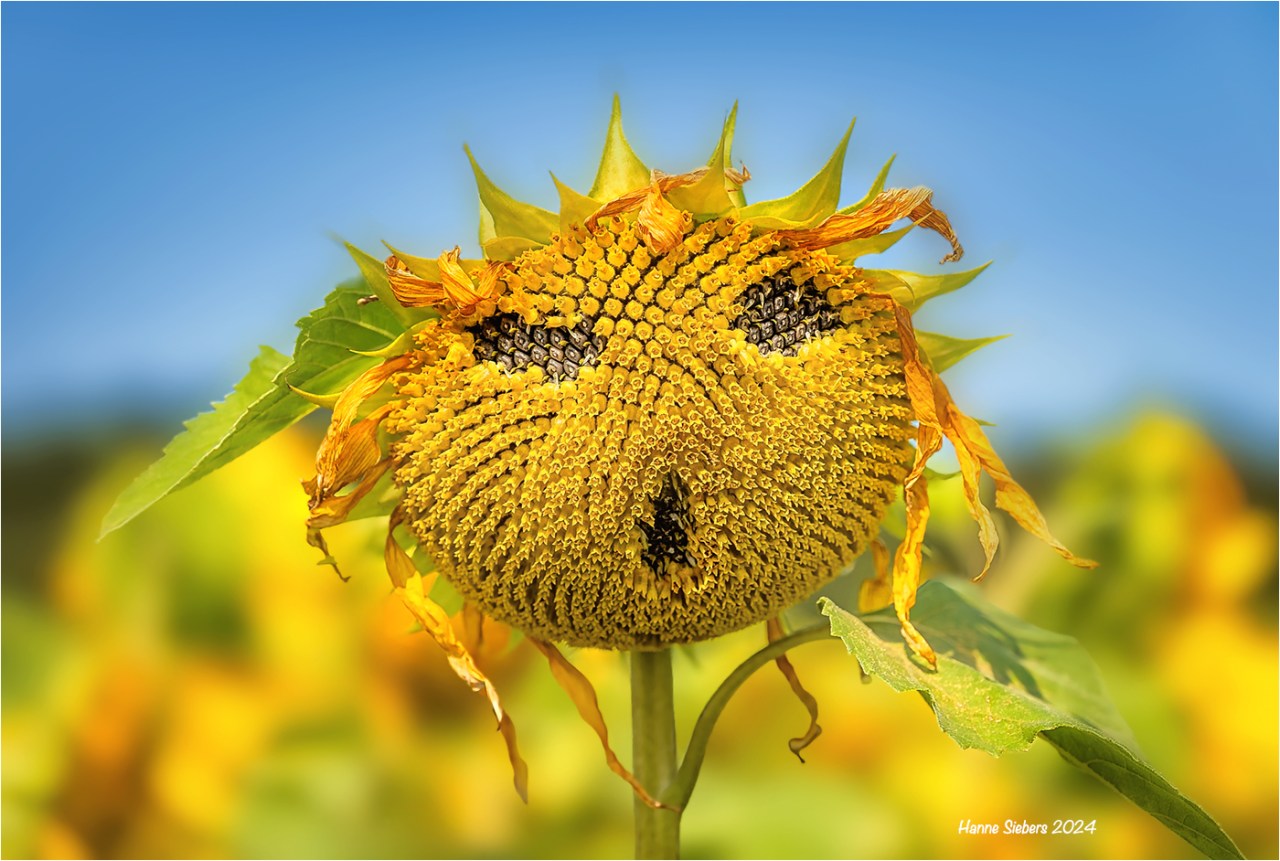
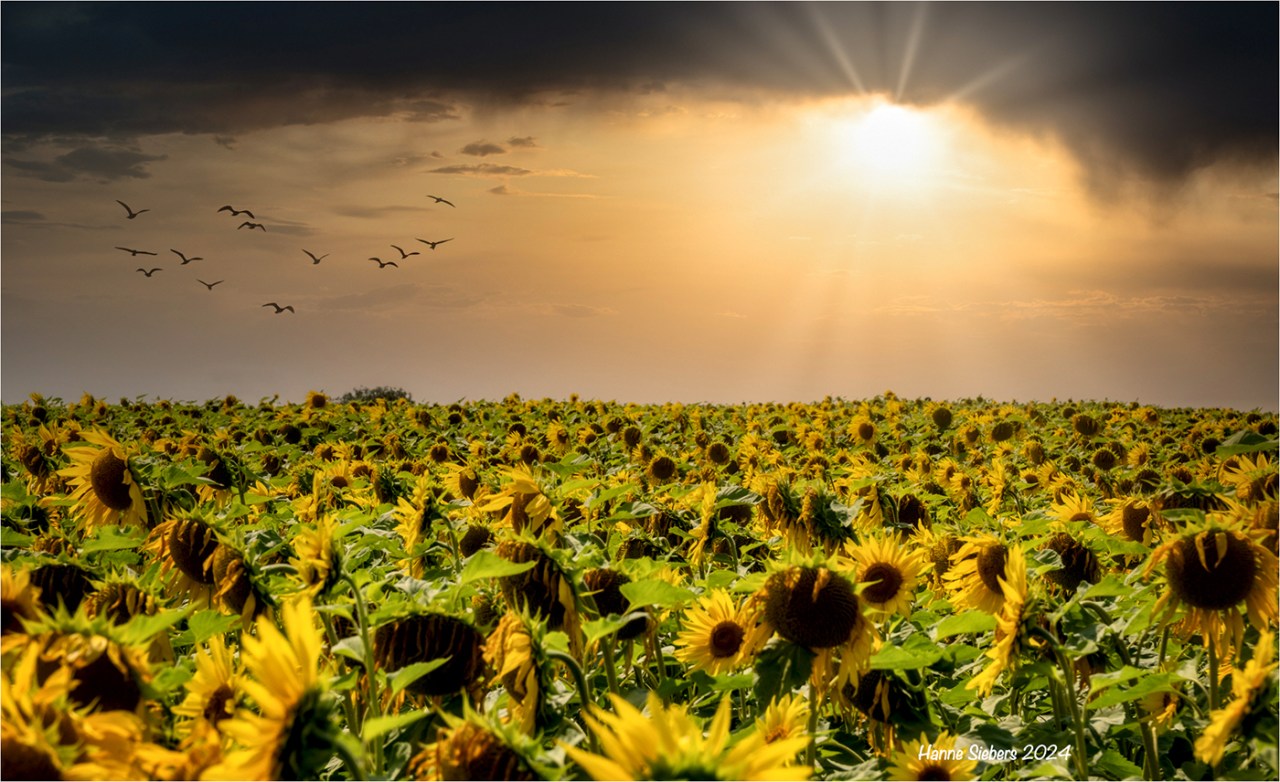
Oh my goodness, sunflowers again. Everyone takes pictures of them, art has dealt with them extensively, but their magic has not diminished. So we drove a few villages further to a sunflower field.
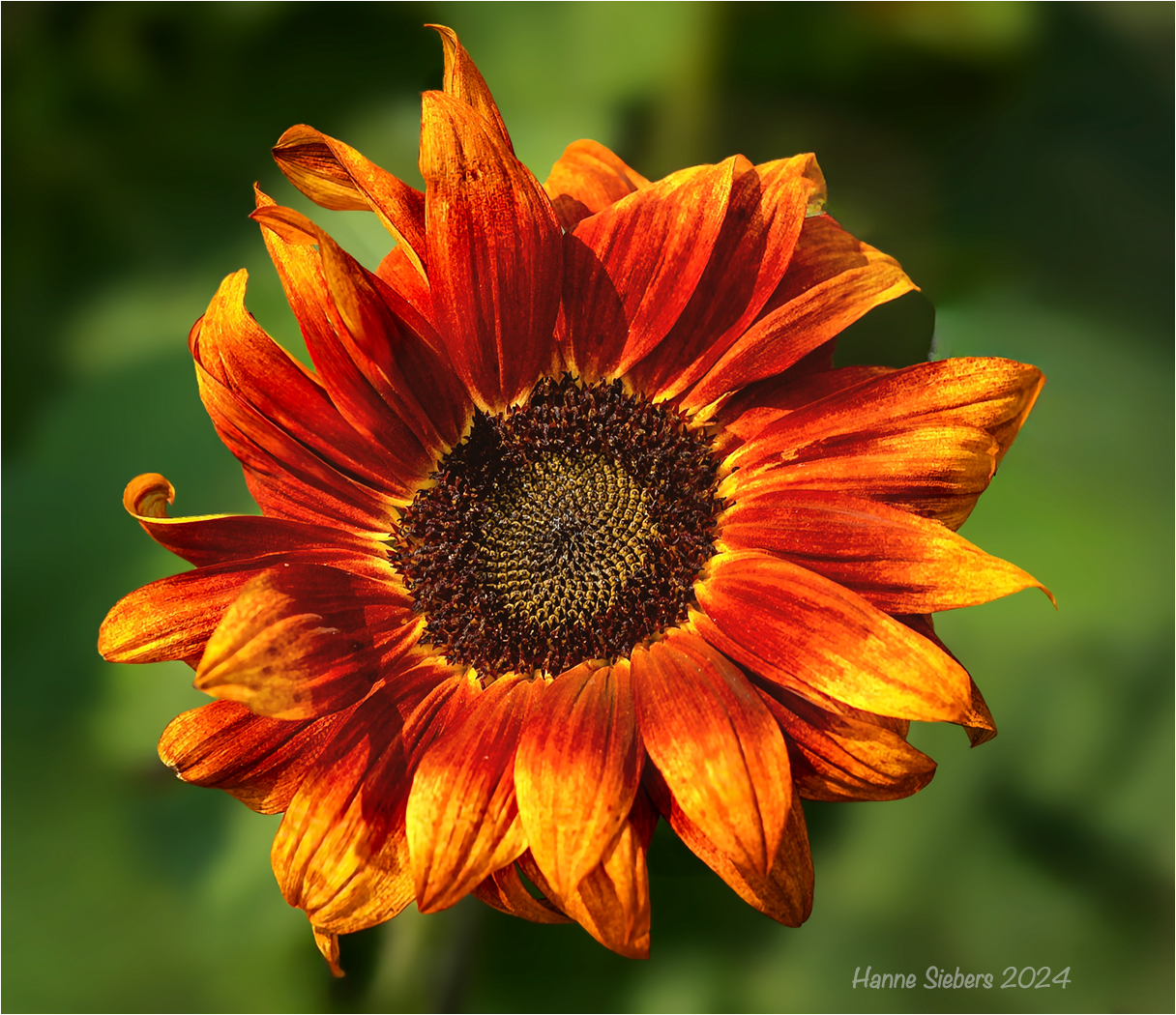
Sadly, the number of these bright yellow sunflower fields is dwindling as they are not very productive. The darker sunflowers from Ukraine produce more oil. At the edge of this field there were also some almost red sunflowers, their seeds are harvested by hand for sowing and propagation.
Ach du meine Güte, schon wieder Sonnenblumen. Jeder fotografiert sie, die Kunst hat sich ausgiebig mit ihnen beschäftigt, und doch hat das ihrem Zauber keinen Abbruch getan. So fuhren wir aufgeregt ein paar Dörfer weiter zu einem Sonnenblumenfeld.
Die Zahl dieser leuchtend gelben Sonnenblumenfelder nimmt ständig ab, denn sie sind nicht sehr ertragreich. Die dunkleren Sonnenblumen aus der Ukraine liefern weitaus mehr Öl. Am Rande dieses Feldes gab es auch einige fast rote Sonnenblumen, deren Samen von Hand geerntet werden, um sie auszusäen und zu vermehren.
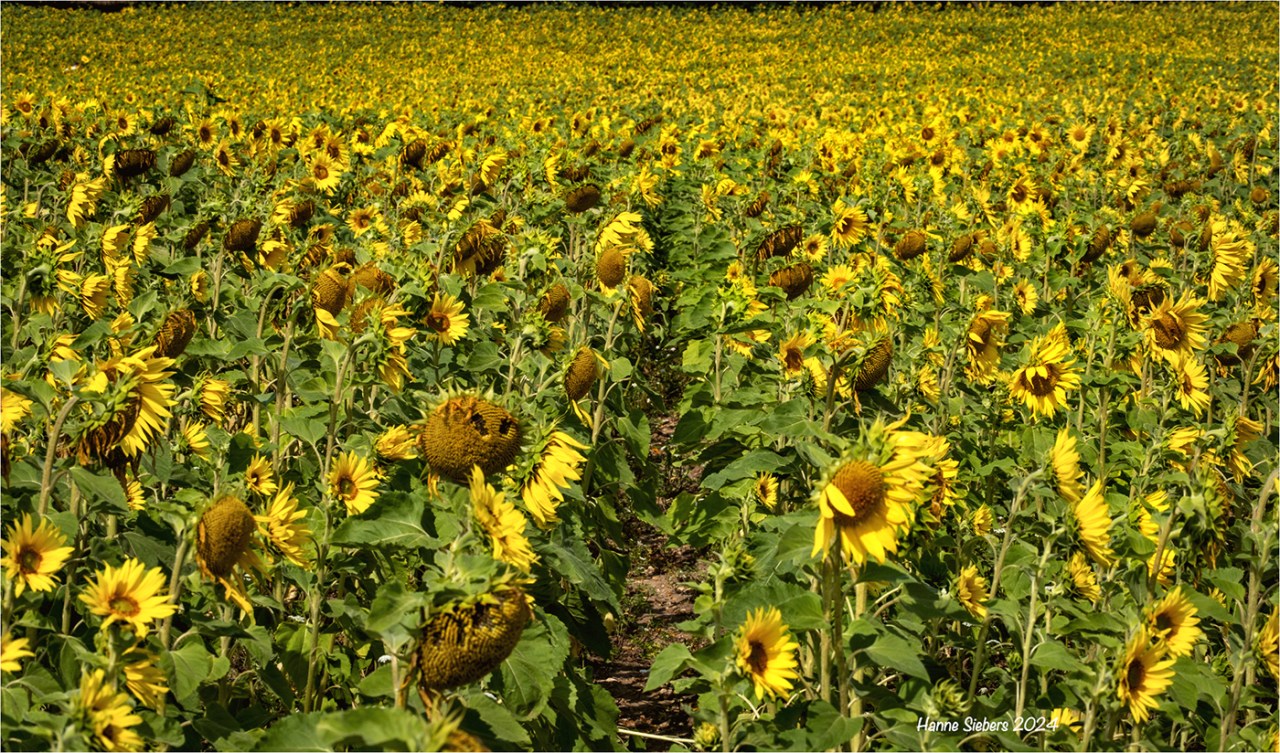
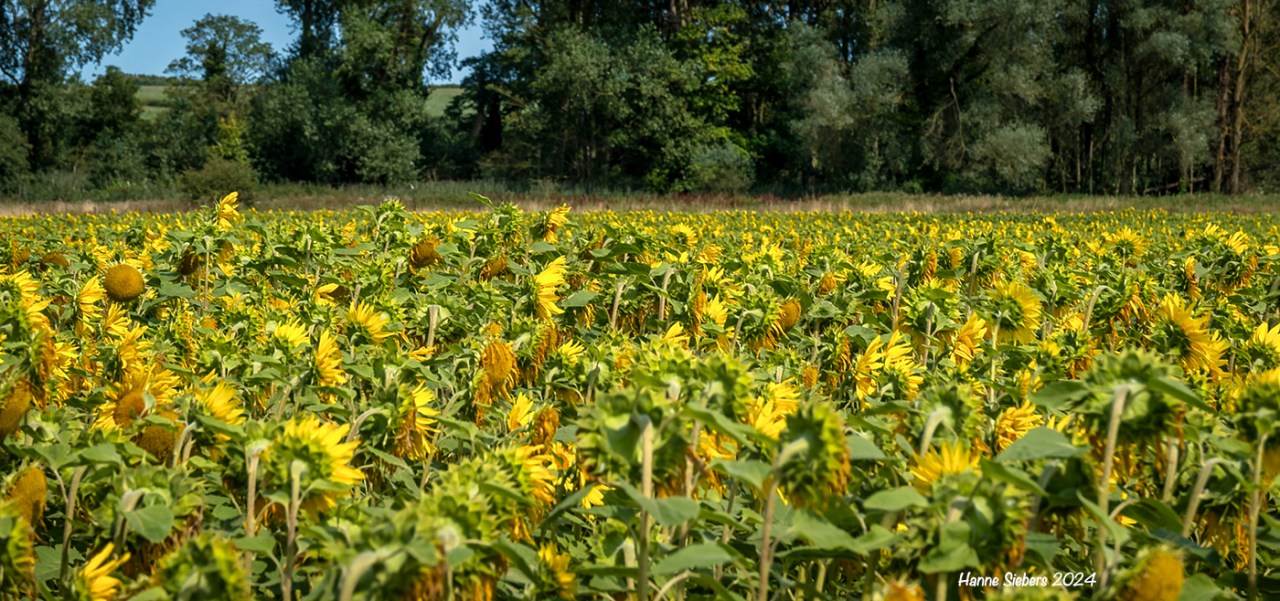
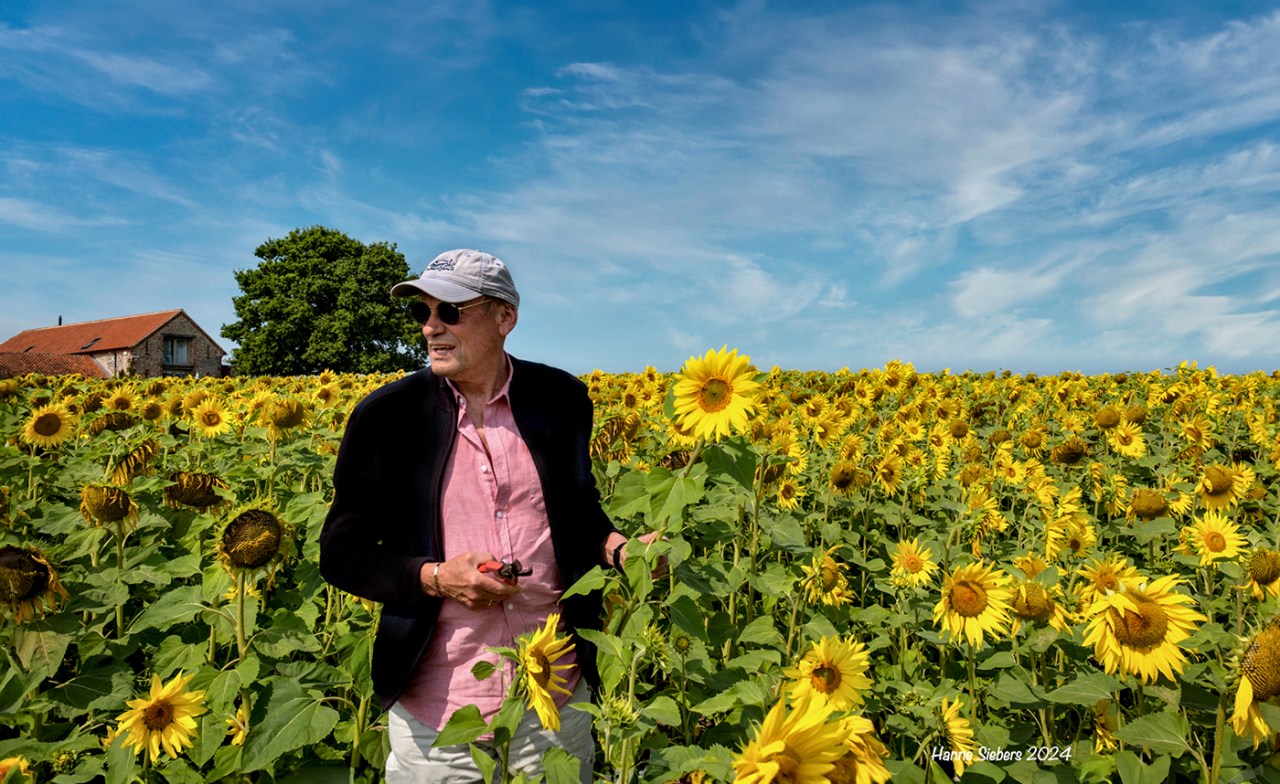
We were overwhelmed by the sight of sunflowers as far as the eye could see. Five football pitches full of sunflowers, with paths leading through the field. Siri and Selma had wisely brought their golden fairy scissors – like the golden Druid sickles – to cut off some sunflowers. They had read that if you cut the sunflowers at an angle and change the water every day, they will last a long time in a vase, just like in a van Gogh painting.
Uns gingen die Augen über. Sonnenblumen so weit das Auge reicht. Fünf Fußballfelder voller Sonnenblumen mit Pfaden, die durch das Feld führten. Siri und Selma hatten in weiser Voraussicht ihre goldenen Feenscheren – wie die goldenen Druidensicheln – mitgenommen, mit denen sie kleinere Sonnenblumen abschnitten. Sie lasen, dass die Sonnenblumen sich, wenn man sie schräg anschneidet und täglich das Wasser erneuert, wie auf einem Bild von van Gogh in der Vase gut halten.
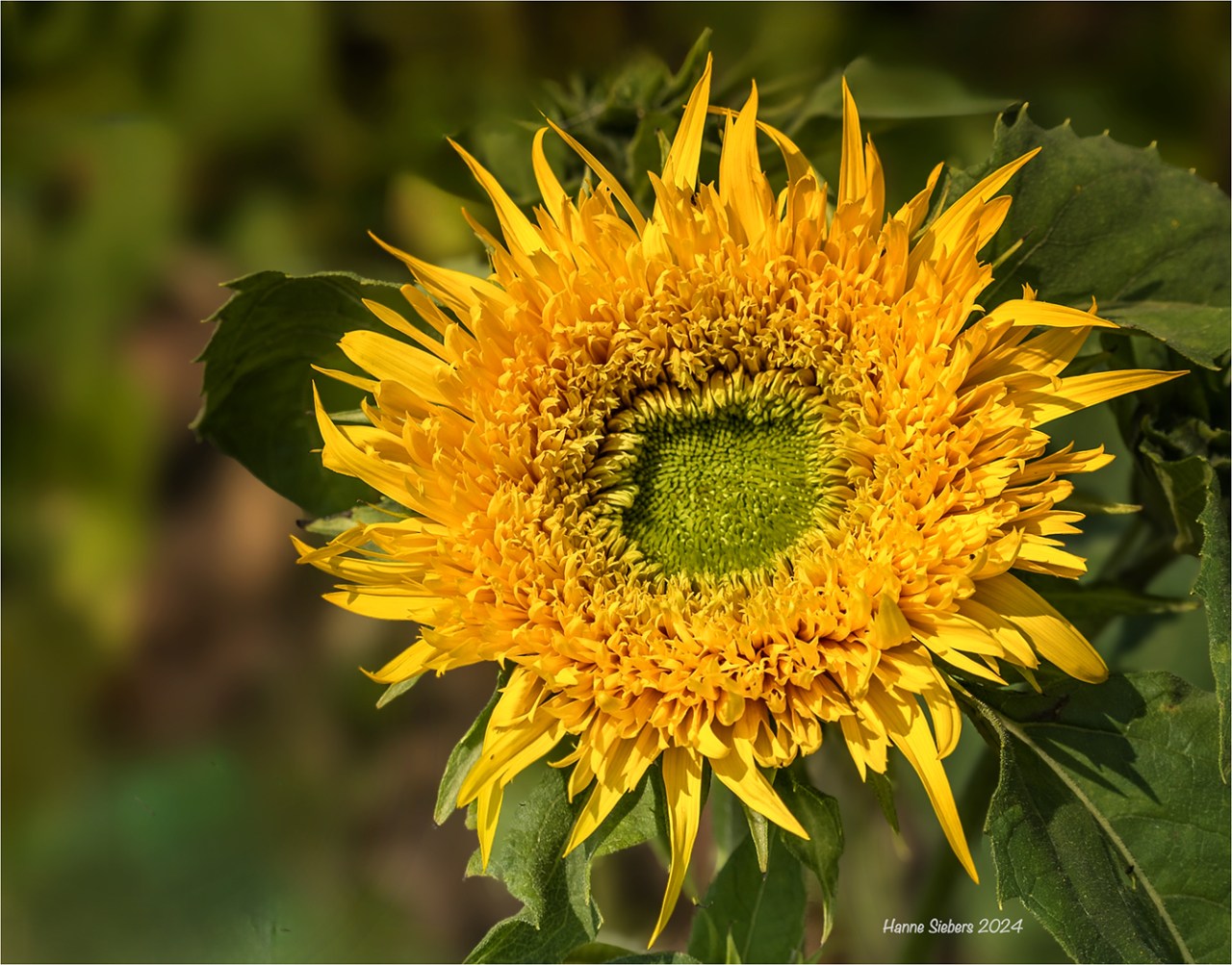
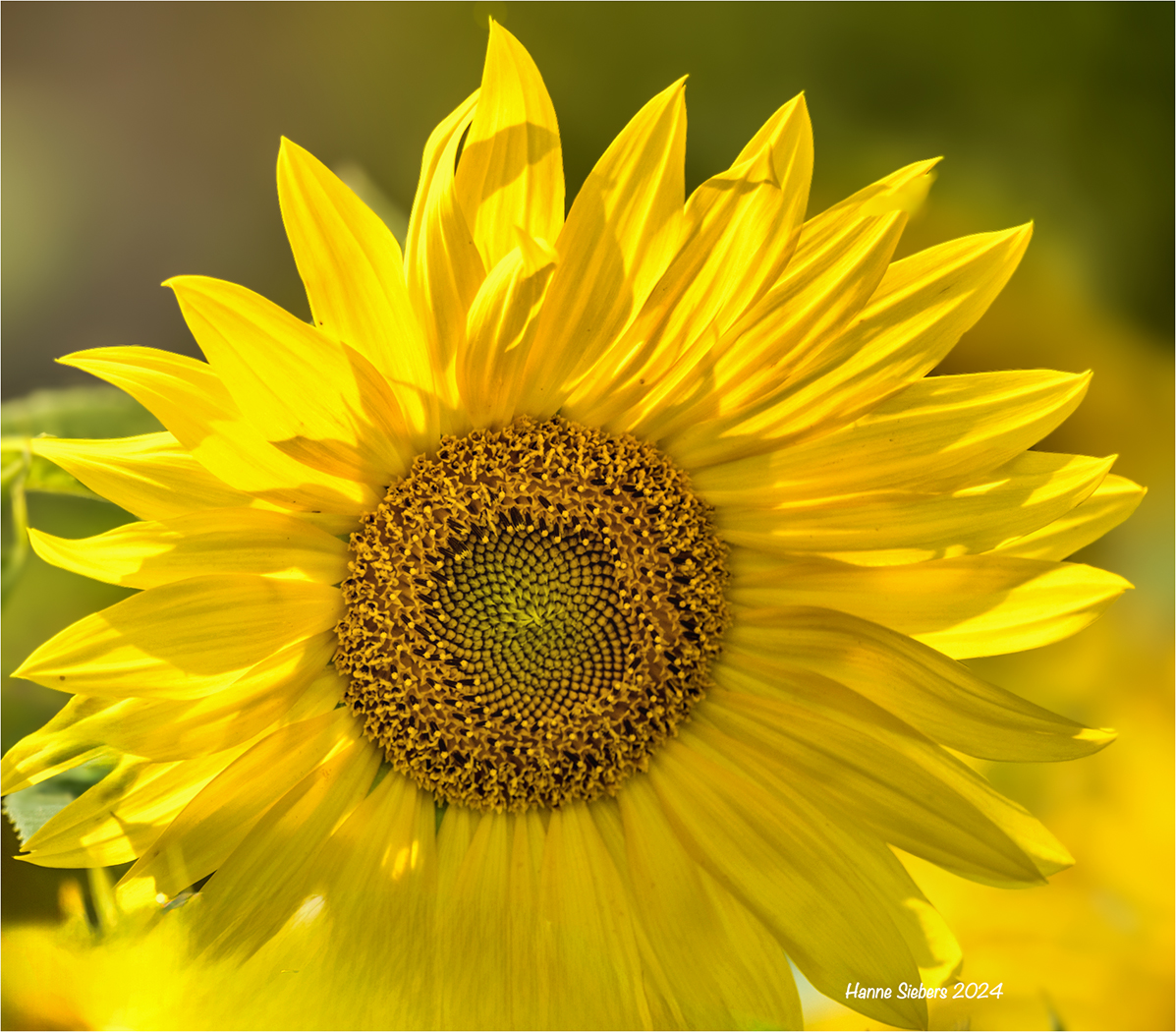

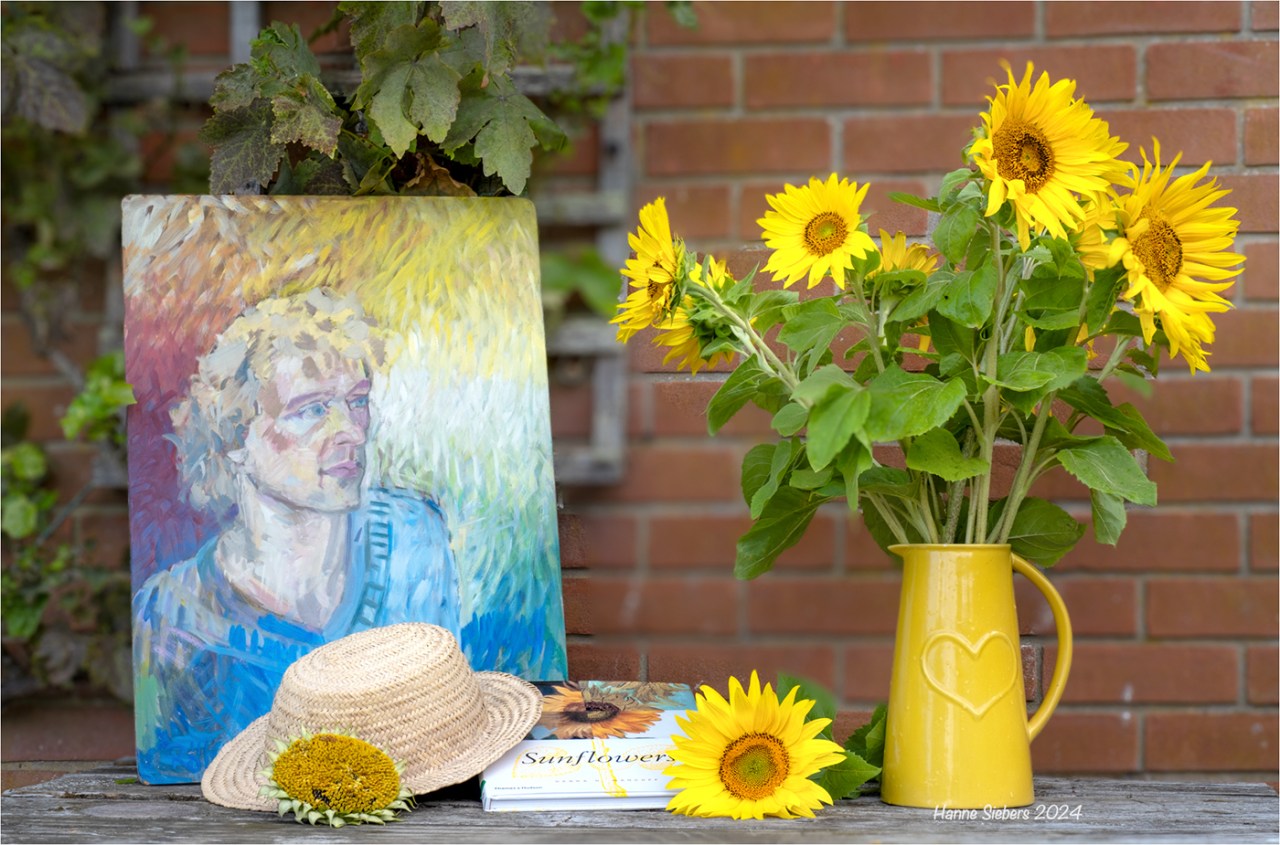
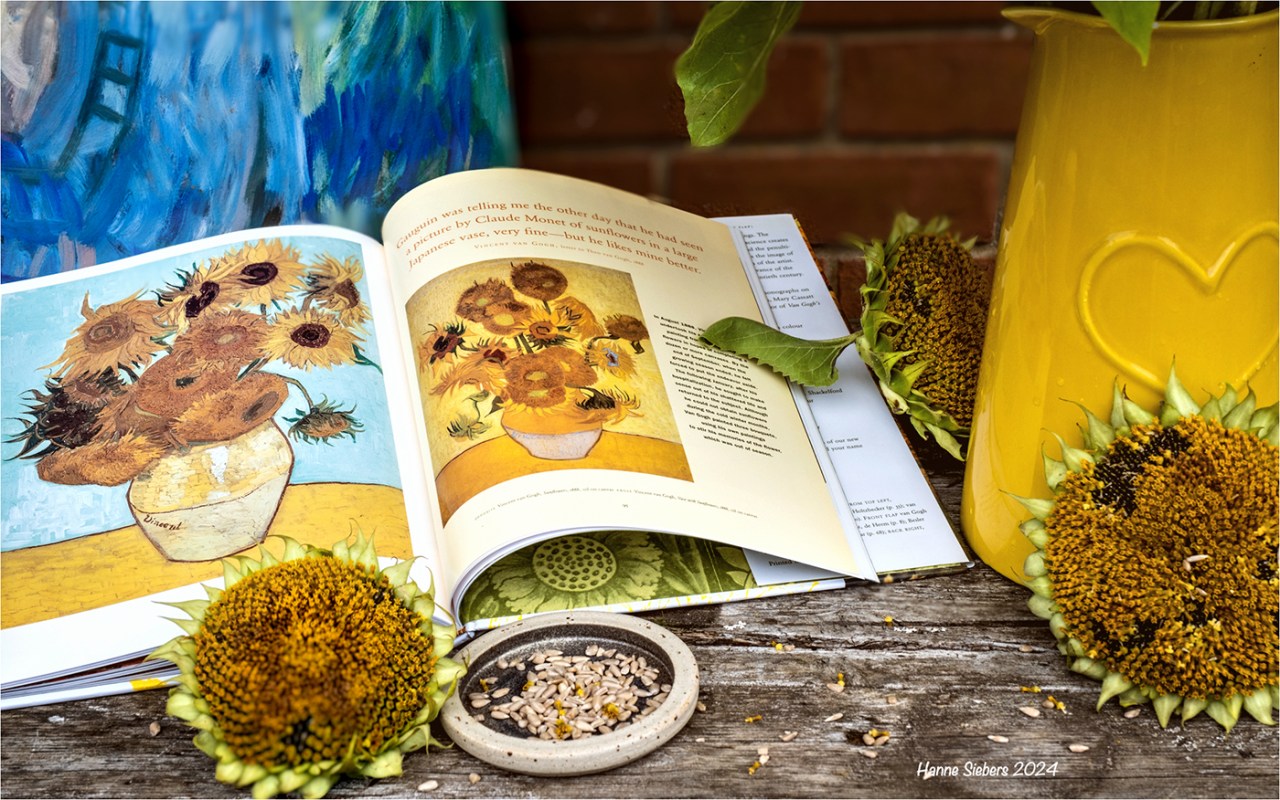
Van Gogh is the painter of sunflowers. He painted cheerful sunflower pictures for his friend Gauguin because they were a perfect match for Gauguin’s ‘Yellow House’ in Arles. However, the friendship broke down due to van Gogh’s mental instability.
Claude Monet and Gustav Klimt also loved sunflowers, Selma had read.
“And they also appear in literature, for example in Tolstoy’s ‘Anna Karenina’,” our well-read Siri knew. “And in Allen Ginsberg’s ‘Sunflower Sutra’, the sunflower is a symbol against the evils of big cities.”
Van Gogh ist der Maler der Sonnenblumen. Er malte seine fröhlichen Sonnenblumenbilder für seinen Freund Gauguin, weil sie perfekt in dessen ‘Gelbes Haus’ in Arles passten. Die Freundschaft zerbrach jedoch an van Goghs psychischer Instabilität.
Auch Claude Monet und Gustav Klimt liebten Sonnenblumen, hatte Selma gelesen.
“Und in der Literatur kommen sie auch vor, zum Beispiel in Tolstois ‘Anna Karenina’“, wusste unsere belesene Siri. “Und in Allan Ginsbergs ‘Sunflower Sutra’ ist die Sonnenblume ein Symbol gegen die Übel der Großstadt“.
“Do you know why sunflowers always turn their heads towards the sun?” asked Siri, and after we shook our heads, she explained that the ancient Greeks already knew. In his Metamorphoses, Ovid tells the story of Clytie, a water nymph who had an affair with the sun god. He abandoned her and turned her into a sunflower. Since then she has turned to the sun with longing, making the sunflower a symbol of fidelity.
That’s how relationships with the gods end, as we all know.
“Wisst ihr, warum die Sonnenblumen ihre Köpfe stets der Sonne zuwenden?” fragte Siri und erklärte nach unserem Kopfschütteln, dass das bereits die alten Griechen wussten. Ovid erzählt in seinen ‘Metamorphosen’, dass die Wassernymphe Clytie ein Verhältnis mit dem Sonnengott hatte. Er verließ sie und verwandelt sie in eine Sonnenblume. Seitdem wendet sie sich sehnsüchtig stets der Sonne zu und lässt die Sonnenblume zu einem Symbol der Loyalität werden.
So enden bekanntlich die Verhältnisse mit den Göttern.
Hanne-Dina likes sunflowers not only because they put her in a good mood when she looks at them, but also because their seeds are popular with our birds. But sunflowers are also healthy for us humans. They regulate blood pressure, lower cholesterol levels and are recommended during pregnancy and breastfeeding because of their folic acid content. But beware! A handful of sunflower seeds has as many calories as a piece of cake.
Hanne-Dina mag Sonnenblumen nicht nur, weil ihr Anblick gute Laune macht, sondern auch, weil ihre Kerne bei unseren Vögeln beliebt sind. Aber auch für uns Menschen sind Sonnenblumen gesund. Sie regulieren den Blutdruck, senken den Cholesterinspiegel und sind wegen ihrer Folsäure in der Schwangerschaft und Stillzeit zu empfehlen. Aber Achtung! Eine Handvoll Sonnenblumenkerne hat so viele Kalorien wie ein Stück Kuchen.
Enough praise for the sunflower. We have reached the end of the local sunflower season and that’s why we’re finishing our sunflower post now. With best regards from the sunny coast
Genug des Lobs der Sonnenblume. Wir sind nun am Ende der hiesigen Sonnenblumensaison angelangt und deswegen machen wir Schluss. Mit lieben Grüßen von der sonnigen Küste.
The Fab Four of Cley
🙂 🙂 🙂 🙂
.
© text and illustrations, Hanne Siebers & Klausbernd Vollmar, Cley next the Sea 2024
 FabFourBlog
I rather like that red one!
LikeLiked by 2 people
Dear Sue
the red ones are rare here but common in Eastern Europe. They produce more oil than the yellow ones.
Thanks for commenting; have a happy weekend
The Fab Four of Cley
🙂 🙂 🙂 🙂
LikeLiked by 2 people
I love sunflowers too. We have fields and fields of them here in Spain. Sunflower oil is almost as popular as olive oil here (and more affordable!) Thanks for the lovely photos.
LikeLiked by 1 person
Thank you very much, dear Darlene.
When the war broke out in Ukraine, sunflower oil became scarce in Central Europe and then almost as expensive as olive oil because the Ukraine was the biggest producer of this oil.
When Kb was a child you could find big sunflower fields everywhere in Southern Germany but now they are nearly all gone. Farmers grow there much more profitable crops.
Thanks and all the best
The Fab Four of Cley
🙂 🙂 🙂 🙂
LikeLiked by 2 people
Dear friends, that’s a sunny and cheerful way to start my day in rainy and wet Oslo. Bjørvika was flooded yesterday and I had to take my shoes off and wade through the water to get to my meeting.
I love sunflowers, a distinct sign the summer has been replaced by autumn. Do we see a young Klausbernd on the second last image? I have a vague feeling I have seen it before? Is it painted with brush strokes or a finger?
Now I want to see the Astrup Fearnley Museum of Modern Art before I return to Stockholm later this evening.
Have a wonderful weekend, FabFour!
Kram
Annalena xx
LikeLiked by 2 people
Our dear friend Annalena,
first of all, have a great time in Oslo. We love Oslo as well, great architecture, museums and art galleries. You remember we blogged about the Astrup Fearnley Museum
https://fabfourblog.com/2017/02/24/brexit-exit-oslo/
https://fabfourblog.com/2017/03/10/lets-go-inside/
The picture of Kb is an old oil painting of his from 1982. It’s done by a quite known antroposophist painter with a brush. He started with the background and worked the face out of the background. An amazing technique.
We have rainy weather here as well. We desperately needed it. This light rain now is ideal for the garden – and the sunflowers.
KRAM
🤗🤗🤗🤗
💜💙💜💙
The Fab Four of Cley
🙂 🙂 🙂 🙂
LikeLiked by 1 person
Wunderschöne Aufnahmen, wie immer.
Schön zu sehen, wie gut es dir geht, lieber Klausbernd.
LG U+H
LikeLiked by 1 person
Liebe Uschi, lieber Herbert
Kb ist wieder genesen, froh und munter. Da sind wir alle froh 🙂
Danke, dass dir Dinas Fotos gefallen
The Fab Four of Cley
🙂 🙂 🙂 🙂
LikeLike
These are absolutely gorgeous images Hanne and Klausbernd. We have quite a few sunflower fields on the eastern end of Long Island and whenever we drive past them it is a sight to behold. I have never seen a red sunflower though, it’s really spectacular. 😊
LikeLiked by 2 people
Thank you very much, dear Joe.
The red sunflowers on this picture coming from Eastern Europe, from the Ukraine. The farmer here tries to multiply their numbers bit by bit. He is not sure if they will have that high oil content like the original ones.
Happy weekend
The Fab Four of Cley
🙂 🙂 🙂 🙂
LikeLiked by 1 person
Aren’t they fabulous! You always have to stop and look. We saw fields and fields of them in Andalucia in May, red ones too. Here they are usually just a few stragglers but still worth a smile. Fab photos, especially the last 🤗🌻🩷
LikeLiked by 2 people
Dear Jo
one can’t just pass by a sunflower field. They bewitch you and make you stop and smile.
These here are quite late ones. It was the day before harvesting when Dina photographed them.
Thanks and Cheers
The Fab Four of Cley
🙂 🙂 🙂 🙂
LikeLiked by 1 person
Lovely to see they bloomed further south than us, the place where I go to photograph sunflowers sent an email saying the weather we’ve had has made the crops fail. Well done Fab 4 and great photos by Hanne!
LikeLiked by 2 people
Good afternoon, dear Fraggle,
when it rains too much in the 80 days between sowing and flowering the crop will fail. Additional the sunflowers need their dose of sunshine during this period.
Thanks for liking Hanne-Dina’s pictures 🙏 🙏
The Fab Four of Cley
🙂 🙂 🙂 🙂
LikeLiked by 1 person
When Europeans first came to North America they found wild sunflowers (Helianthus annuus) growing in many places across the continent. Europeans took sunflowers back to Europe and spent centuries breeding them to get larger and larger flower heads like the ones in Van Gogh’s paintings and many people’s gardens today. The original wild sunflowers still grow abundantly in many parts of the United States. Here in Texas they have a reputation for liking disturbed ground, and it’s common to see them springing up on mounds of earth at construction sites for highways and buildings.
LikeLiked by 3 people
Dear Steve
thank you very much for your info about the North American sunflowers.
Here we have to grow sunflowers in our gardens and nurture them. To our knowledge there are no wild sunflowers here. However, the situation seems to be different in Eastern Europe.
Keep well, healthy and happy
The Fab Four of Cley
🙂 🙂 🙂 🙂
LikeLike
I think especially Dina’s last picture would best go together with the very bad hailstorm we had in our region approx. 2 months ago, which not only unrooted big trees, destroyed our garden and shredded the beautiful sunflowerfields! As I love these flowers very much, I thank you all for your touching post! All the best:)
LikeLiked by 2 people
Dear Martina
oh dear, a hailstorm destroyed your garden. What a pity. Fortunately we rarely have extreme weather condition here. The early summer was too wet followed by a draught. Today is the first rainy day for ages. We love the rain and our garden loves it even more. It’s so cosy sitting inside our conservatory blogging about sunflowers.
Sunflowers make you happy, don’t they?
We wish you a happy and healthy time
The Fab Four of Cley
🙂 🙂 🙂 🙂
LikeLiked by 1 person
Well, dear Klausbernd, to be in a situation, where you realize that you can’t do anything against the power of nature, takes time to get used to. Now, we too are just looking forward to a normal day of rain and to a lot of sunflowers for our wellbeing next year!
Many thanks for your kind words, Klausbernd and many little pleasures:)
LikeLiked by 2 people
We keep our fingers crossed for a coming year with your garden full of big smiling sunflowers 🤞🤞🤞🤞
LikeLiked by 1 person
👏🌻🌻🌻🌻👏
LikeLiked by 2 people
What a nice feast for the eyes! Thank you for sharing these beautiful photos with us!
LikeLiked by 2 people
Dear Hien
we agree, the sunflowers look great. It’s this friendly yellow that Goethe called in his ‘Theory of Colour’ “the colourful representative of light“.
Thanks for your comment 🙏 🙏
The Fab Four of Cley
🙂 🙂 🙂 🙂
LikeLike
There is no happier flower, in my opinion. I have seen them turn to face the sun in the past during my long walks with Ollie. When we left, the heads faced in a southerly direction, and on our return to the same spot some hours later, they were facing west as the sun lowered in the sky.
Love from Beetley, Pete. X
LikeLiked by 2 people
We agree, dear Pete, the sunflower is the flower that radiates the strongest feeling of happiness.
The early Greeks were fascinated with their heliotropism like you.
You seem to have walked for quite a while with Ollie. We try to walk 10.000 steps every day, but often we don’t succeed 😦
Thanks and Cheers
The Fab Four of Cley
🙂 🙂 🙂 🙂
LikeLike
When Ollie was younger, I would usually be out for four hours with him in the afternoon. In good weather, I might extend that to five hours because we have rivers nearby where he could drink and cool down. Once he had arthritis, I had to cut that down to under two hours every day, then eventually to 90 minutes before he died. x
LikeLiked by 2 people
WOW! We are impressed; four to five hours walking is quite something.
LikeLiked by 2 people
These days without Ollie, I usually still manage two hours a day, KB. If I don’t loiter, that is around 6 miles at a regular walking pace. x
LikeLiked by 2 people
I cover usually the same distance as you do nowadays, Hanne-Dina does much more.
LikeLiked by 2 people
Sunflowers, favorites of so many including yours truly. We occasionally get fields of them nearby when farmers choose them to re-fertilize their fields in off years. They are a photographer’s dream as Hanne-Dina has shown with the beautiful images in your post. A lovely ode to them as they raise their beautiful heads to the sun.
LikeLiked by 2 people
Dear Tina,
Here fewer and fewer farmers grow them and those who do change the fields every year. But they complain it’s not profitable any more. So they try to get some extra income with opening their fields to the public and organise special events for photographers and schools.
Thank you very much for kind comment
The Fab Four of Cley
🙂 🙂 🙂 🙂
LikeLiked by 1 person
Sunflowers make you smile. It’s been a long time since I saw a field full of them. I did try and grow some myself a couple of years ago, not very successfully, the slugs made short work of them, but a couple of the red ones grew and I like those. I do recall RHS Wisley having sunflower trials years ago with some very unusual varieties including one called teddy bear!
I love the still life photos here Hanne. That is one gorgeous yellow jug.
Love to you all from a very windy but sunny Cornwall xx
LikeLiked by 2 people
Dear Jude
we experienced the same growing sunflowers in our garden. We tried it every year for at least the last ten years and only once we succeeded in getting a high big sunflower. We don’t know what we do wrong – actually we do nothing. We think it’s the deadly combination of slugs and muntjacs.
Here it was quite windy as well. We had a rough sea and nobody was allowed to go out fishing. But now the weather has changed. The wind dropped and fortunately it rains after a sunny and warm period.
Lots of love 💜💙 from the rainy Norfolk coast
The Fab Four of Cley
🙂 🙂 🙂 🙂
LikeLiked by 2 people
Glorious! I have never seen huge fields of sunflowers. I am not sure if they are grown in any great numbers in Maine. Anyway, what a treat, and I especially liked the story of why they follow the sun.
LikeLiked by 2 people
Dear Laurie
We can’t remember to see sunflower fields when we lived in Vermont. Maybe the climate is too rough and Maine lies even more northerly.
Here sunflowers are not grown that often as farmers can make a bigger profit with other crops. It’s mostly sugar beet or even rye and wheat here.
You will find a lot of those stories when you read Ovid’s ‘Memorphosis’ – but Kb hated it when he had to read it in his Latin lessons at school.
Keep well & thank you
The Fab Four of Cley
🙂 🙂 🙂 🙂
LikeLiked by 2 people
What an uplifting post. I’m pondering your words “they will last a long time in a vase, just like in a van Gogh painting” Hmm…
LikeLiked by 2 people
Thank you, dear Jacqui 🙏 🙏
We have ten sunflowers in a vase we cut in these fields over a week ago and they still look great. It’s Siri’s and Selma’s duty to cut them every morning and give them new water. They like it and feel like sunflower-fairies 🧚♀️🧚♀️
Try it out, you will love it. That is sunshine in the house 🌻🌻🌻
Happy weekend
The Fab Four of Cley
🙂 🙂 🙂 🙂
LikeLiked by 1 person
And they are beautiful, yes, and happy too. They always make me smile. In Spain we saw endless fields of them some years ago – of course we stopped to take photos. Love your stories and Dina’s images. The still life photos are beautifully arranged and make me wonder why I do not grow these flowers… I guess I got the answer from your comments. thank you for making me smile!
LikeLiked by 2 people
Good afternoon, dear Ann-Christine
at last it rains and we are so happy, sitting in our cosy conservatory blogging.
Kb and Siri are seeing it like you that Dina’s still lifes are great; they prefer them to her wildlife photography. It’s more creative.
We are wondering why there are those big sunflowers field in Spain whereas in the UK and Germany the farmers are giving up to grow them because they are not profitable enough for them to grow. When Kb was a child there were many sunflower field in Germany but like in England they are nearly all vanished.
Thank you for your comment.
Have a happy and healthy time
The Fab Four of Cley
🙂 🙂 🙂 🙂
LikeLiked by 1 person
Interesting – and in Sweden we hardly have any. I guess things might change though.
LikeLiked by 2 people
It could be that in more northern countries the sunflowers produce less oil and therefore it doesn’t pay to grow them. But that’s a guess only.
LikeLiked by 1 person
I would say it’s a good one.
LikeLiked by 2 people
Gorgeous photos! When I was eight years old I decided to take a different route when walking home from school one day. There was a house that had several very tall sunflowers in the front garden. I have loved them ever since. 🙂
LikeLiked by 2 people
Dear Mermaid
we can well understand your fascination. Sunflowers are so fascinating because of their bright yellow colour, because they are that big and the flower looks like a smiling face. Sunflowers are just happy-feeling-flowers 🌻🌻🌻
Thanks and Cheers
The Fab Four of Cley
🙂 🙂 🙂 🙂
LikeLiked by 2 people
I love sunflowers. They can create a smile, happy frenzy. These are beautiful images Fab 4!
LikeLiked by 2 people
Thank you so much, dear Anne 🙏 🙏
Have a weekend full of smiles and happiness
The Fab Four of Cley
🙂 🙂 🙂 🙂
LikeLiked by 2 people
Definitely happy flowers.
LikeLiked by 3 people
Dear Anneli
indeed!
🌻 💜 💙 🌻
Thank you
The Fab Four of Cley
🙂 🙂 🙂 🙂
LikeLiked by 2 people
What a fabulous post to read this morning. Vancouver is under the influence of the rain god who whispers that autumn is coming soon. Do you remember the day The Fab Four of Cley took us to this place of sunflowers that went on and on an on…..? Hanne-Dina capture a photo of Don and me in the middle of this field of gold. It is one of my most precious photos.
I find that sunflowers, with their vibrant yellow petals and towering stalks, are a true embodiment of joy and warmth. These cheerful blooms not only brighten gardens and fields but also symbolize adoration and loyalty. Their ability to turn towards the sun god inspires me to seek light and positivity in my life. Sunflowers evoke a sense of happiness that can uplift any spirit.
Thank you for bringing sunshine to my day. Sending much love and many hugs to our dear friends, The Fab Four of Cley!
LikeLiked by 2 people
Dear Rebecca,
we had a day of rain as well but now the sun is shining again and it’s quite warm.
We always tried to grow some sunflowers in our garden but we didn’t succeed. Slugs and muntjacs ate them, we suppose. It would be great to have these flowers of happiness in front of our doorstep. We don’t give up, Siri and Selma did collect the seeds from the strongest sunflowers in the field we visited.
We darkly remember that we took you to that sunflower field. Unfortunately we can’t find this picture anymore.
Thank you very much for visiting and commenting.
We send love ❤ 💙💜 ❤ and 🤗 🤗
The Fab Four of Cley
🙂 🙂 🙂 🙂
LikeLiked by 2 people
Oh Klausbernd. You don’t have the photo. Hanna-Dina used my camera to take the photos so they are in my photo collection. She has a marvelous way to capture ordinary moments and create extraordinary memories.
LikeLiked by 2 people
Now I understand – thank you.
❤ 💙💜 ❤
LikeLiked by 2 people
We don’t experience such vast stretches of sunflowers here in Ireland but they are popular garden plants, generally sown for the enjoyment and amazement of children who are surprised to grow a plant greater then themselves from a small seed they planted. The television coverage of the Tour de France always features great views of sunflowers! Lovely post. Many thanks!
LikeLiked by 2 people
Good morning, dear Paddy,
we are all still surprised how such a big plant can grow from such a small seed. Isn’t it amazing how high sunflowers get and how big and heavy their flower becomes?
Especially in the south of France you find big sunflower fields. Here they are rather rare.
Thank you very much for your kind comment
The Fab Four of Cley
🙂 🙂 🙂 🙂
LikeLiked by 2 people
I love sunflowers! They’re my favorite! I wish I lived near a sunflower field!
LikeLiked by 2 people
Thank you very much, dear Dana.
All the best
The Fab Four of Cley
🙂 🙂 🙂 🙂
LikeLiked by 1 person
Lovely! Painting is beautiful.
LikeLiked by 2 people
Dear Cindy
thank you very much.
The painting was done for more than forty years ago by an anthroposophist painter who became quite famous later on for his technique. He started with the background and kind of modelled Klausbernd’s picture from there following Goethe’s colour theory.
Keep well
The Fab Four of Cley
🙂 🙂 🙂 🙂
LikeLiked by 1 person
Travelling to my b&b I noticed a field of Sun Flowers.
I love them all, in every color.
Kind regards,
LikeLiked by 2 people
Dear Rob
we do as well.
We are still fascinated how hight they get and how big their flowers grow.
Thank you 🙏 🙏
All the best
The Fab Four of Cley
🙂 🙂 🙂 🙂
LikeLike
Sunflowers en masse are among the glories of the farming calendar. Thank you for these!
LikeLiked by 2 people
We absolutely agree with you, dear Margaret.
Thanks and keep well
The Fab Four of Cley
🙂 🙂 🙂 🙂
LikeLiked by 1 person
Fab Four of Cley,
What a lovely subject to land on in the middle of this rather warm Summer. It is interesting to note the different types and their high caloric rate. Their benefits might be counteracted by the weight one gains while eating them.
I enjoyed the story of the nymph and the Sun. Old tales always seem to have such endings.
Enjoy the remainder of your weekend.
GP
LikeLiked by 2 people
Our dear friend GP
The sunflowers don’t need that much rain because their roots grow very deep, much deeper than normal flowers grow their roots.
There many types of sunflowers. One is called ‘Ring of Fire’. We only know it from pictures. It looks amazing.
We love these old tales. Ovid’s “Metamorphosis’ is full of them. A lot of modern tales go back to Ovid.
We have a long weekend here in England because tomorrow is a bank holiday.
Thank you very much 🙏 🙏
The Fab Four of Cley
🙂 🙂 🙂 🙂
LikeLiked by 1 person
I read Ovid too many years ago to remember, but it doesn’t surprise me that he has been copied.
I looked up the ‘Ring of Fire sunflower, and I do agree at beauty!
Thank you
GP
LikeLiked by 2 people
I love the red one too.
LikeLiked by 2 people
We as well, dear Reena.
Thanks & Cheers
The Fab Four of Cley
🙂 🙂 🙂 🙂
LikeLiked by 1 person
Sunflower fields are so beautiful. Thank you for the interesting post. Enjoy the ☀️
LikeLiked by 2 people
Thank you very much, dear Ute.
We’ll go tomorrow to Holkham and have a lazy beach day. Well, not exactly because Dina wants to photograph there. There is the rumour that the household royal cavalry will ride along the beach. We’ll see.
We are fascinated by sunflower fields as well. It’s the masses of this big yellow flowers that fascinates.
Enjoy the bank holiday
The Fab Four of Cley
🙂 🙂 🙂 🙂
LikeLiked by 1 person
Gorgeous images Hanne, sunflowers in every hue and shade are such a joy to see 💜🌻
LikeLiked by 2 people
Thank you very much, dear Xenia, for your kind comment.
All the best
The Fab Four of Cley
🙂 🙂 🙂 🙂
LikeLiked by 1 person
It may be difficult but Dina did a marvelous job of capturing the vases of the sunflower field. A Fun post F4oC
LikeLiked by 2 people
Dear John
thanks a lot for liking Dina’s photography.
Keep well
The Fab Four of Cley
🙂 🙂 🙂 🙂
LikeLiked by 1 person
She is very talented.
LikeLiked by 1 person
We’ve seen lots of sunflowers in South Dakota, but never those red ones. Cute sunflower faces, love the yellow pitcher, and also that last photo. I feel more cheerful after your delightful post. 😁 🌻
LikeLiked by 2 people
These red sunflowers seem to be native to Eastern Europe. But some farmers try to grow them here as well recently.
We learned from Steve Schwartzman’s comment that sunflowers, we suppose the yellow ones, are native to North America.
GREAT that our post made you feel cheerful. We love to read that 🙂
With kind regards ❤
The Fab Four of Cley
🙂 🙂 🙂 🙂
LikeLiked by 1 person
“t’s difficult to capture the impact of 5 football fields filled with sunflowers”
Das stimmt. Bei HJ Schlichting sah ich mal ein Feld von Magariten.
Meine Schätzung war: 50.000.
Ich weiß jetzt nicht, wieviele Sonnenblumen es hier sind, aber so schnell wird eine Miillion nicht erreicht.
In anderen Zusammenhängen redet man – oft – von Millionen, Milliarden oder sogar Billionen.
Niemand weiß aber, was diese Zahlen bedeuten.
LikeLiked by 2 people
Lieber Gerhard
wir haben keine Ahnung, wie viele Sonnenblumen auf diesem Feld blühen. Die Faszination liegt u.a. in der Menge.
Wenn wir von Millionen oder gar Milliarden sprechen, ist das oft metaphorisch gemeint für sehr viel. Auf jeden Fall wachsen auf diesem großen Feld sehr viele Sonnenblumen. Bei Sonnenblumen ist alles groß, nicht nur ihre Anzahl hier, auch ihre Höhe und die Größen und das Gewicht ihrer Blüten.
Danke für deinen Kommentar
The Fab Four of Cley
🙂 🙂 🙂 🙂
LikeLiked by 1 person
Beautifully written piece on sunflowers.
LikeLiked by 1 person
Dear Sadje
thank you very much 🙏 🙏
We wish you a wonderful Sunday
The Fab Four of Cley
🙂 🙂 🙂 🙂
LikeLiked by 1 person
Thanks 😊
LikeLiked by 1 person
Das letzte Bild ist einfach traumhaft schön! Danke auch für die Erzählung der Liebesgeschichte zwischen Clytie und dem Sonnengott. Das erklärt, warum die Sonnenblumen so unglaublich viel Wasser benötigen.
Liebe Grüße,
Elvira
LikeLiked by 3 people
Liebe Elvira
habe herzlichen Dank für deinen Kommentar.
Es bedarf der Liebe, um zu solch schöner und freundlicher Blume zu werden. Allerdings warnt diese Geschichte zugleich davor, sich mit einem (Sonnen)Gott einzulassen.
Mit lieben Grüßen vom sonnigen Meer
The Fab Four of Cley
🙂 🙂 🙂 🙂
LikeLiked by 1 person
Wow! Spectacular ending photo.
LikeLiked by 2 people
Thanks, dear David 🙏 🙏
Great that you like Dina’s picture that dramatically marks the end of our post
The Fab Four of Cley
🙂 🙂 🙂 🙂
LikeLiked by 1 person
My favourite flower!!
LikeLiked by 1 person
Hi Maria
it’s ours as well.
Thanks for commenting
The Fab Four of Cley
🙂 🙂 🙂 🙂
LikeLiked by 2 people
I love sunflowers and learned a great deal more about them from this post and comments. Thank you! ❤
LikeLiked by 2 people
You are very welcome and thanks for your comment.
All the best
The Fab Four of Cley
🙂 🙂 🙂 🙂
LikeLiked by 1 person
Good morning dear friends,
I have tried to grow sunflowers with various results over the years.
They are amazing flowers and always put a smile on my face.
I suppose you need a drone to get a slightly elevated view to capture the vastness of the place. Have you ever thought about drone photography, Hanne?
I quite enjoyed reading the historical novel “The Secret life of Sunflowers” last year.
Klem
Per Magnus x
LikeLiked by 2 people
Our dear friend Per Magnus,
not before yesterday we heard about the novel ‘The Secret Life of Sunflowers‘. We will read it – but there are big piles of books waiting to be read.
At home at yours in the High Arctic there aren’t any sunflowers, of course, but at your second home in Weimar you have a chance. We didn’t see any in Goethe’s garden there.
Hanne-Dina will answer your question about a drone later. Now we are going to Holkham as we have a bank holiday today and beautiful weather.
With lots of love from us all
KLEM
🤗🤗🤗🤗
The Fab Four of Cley
🙂 🙂 🙂 🙂
LikeLiked by 1 person
A wonderful sight
LikeLiked by 2 people
Dear Derrick
indeed, it is. We love it.
Thanks for your comment.
Wishing you a wonderful week
The Fab Four of Cley
🙂 🙂 🙂 🙂
LikeLiked by 3 people
A brilliant array of the magical beauty sunflowers bring to any day ~ and Dina’s photos bring out this aura of golden light and mood like no other I’ve seen. As summer begins to tilt to an end, this post and writing are so fitting. I wish I could have been alongside Siri and Selma and watched them expertly handle their “golden Druid sickles” with a touch only fairies can manage. Cutting them at an angle is an excellent piece of advance, making it possible to watch them shine day after day just a little longer. A great photo of Klausbernd amid the creative art that sunflowers bring out. Wish you all a beautiful finish to the summer season… 🌻
LikeLiked by 2 people
Thank you VERY much, dear Randall, for your kind comment.
Siri & Selma would have loved to show you how to cut with their golden Fayrie scissors. That’s an art you learn in their Fairie School.
Autumn is in the air. We like that when the vegetation will rest until the next spring. After abundance comes minimalism, which we also enjoy. But we still have some sunflowers in the yellow jug in our conservatory.
Wishing you a wonderful time, health and happiness
The Fab Four of Cley
🙂 🙂 🙂 🙂
LikeLiked by 1 person
Actually, I love sunflowers and like to walk into their massive jungles :-). What I noticed, they never following the Sun, they are all the time looking to the East where the Sun is rising.
LikeLiked by 1 person
Hi Alexander
it seems to be different here. In the fields as even in the vase their heads are following the sun. It seems to be in Greece as well, as Ovid already noticed their heliotropism which is actually not that unusual. You can notice it in many plants like daisies, poppies, tulips, dandelions and buttercups f.e.
We suppose your sunflowers get most of their light from the east all day long. Otherwise it would be an exception that is worth to examine.
Thanks and cheers
The Fab Four of Cley
🙂 🙂 🙂 🙂
LikeLiked by 1 person
Probably, here in Ontario they behave different. I’ve read before and heard a lot of opinions about their following the Sun. However, every single day I pass the huge fields of sunflowers in the morning and in the evening and their heads lean to the East no matter what time of the day and where the Sun is.
LikeLiked by 2 people
These are the heads of mature (old) sunflowers that only face east before they die. Incidentally, this in no way speaks against heliotropism, but is an evolutionary adaptation of old plants to specific ecological niche conditions, such as protection from too intense midday sun. Before ripening, all sunflowers throughout the world show a clear movement of their heads synchronised with the position of the sun.
LikeLiked by 1 person
What’s not to love about sunflowers! I once rode my bicycle across the state of North Dakota where the sunflowers go on for miles and miles… and miles. It’s kind of like driving through Iowa where corn does the same thing, except the sunflowers are prettier and do their little trick of always facing the sun. Thanks for entertaining us with words and photos, as always! –Curt
LikeLiked by 2 people
Thank you very much, dear Curt. We haven’t read from each other for a long time. We hope you are well.
Here in Norfolk as in the UK in general we have rarely huge sunflower field. For us it was something very special to visit this field.
Wishing you all the best
The Fab Four of Cley
🙂 🙂 🙂 🙂
LikeLike
I’ve been a bit tardy on reading blogs, especially when Peggy and I are wandering, which is the majority of the time, Klausbernd. Trying to do better. Grin.
As for sunflowers, huge fields that go on and on are impressive in their own right!
Peggy and I are both doing great, although at 81 there are a few more aches and pains. 😳 The very best to the Fab Four as well!
LikeLiked by 2 people
Dear Curt
that’s great that Peggy and you are still wandering at your age.
Well, there are more important things than blogging.
Keep well
The Fab Four of Cley
🙂 🙂 🙂 🙂
LikeLike
We do wandering well, Klausbernd! Thanks. We’ll be on the Danube in 3 weeks.
LikeLiked by 2 people
Dear Curt
wishing you a happy time at the Danube.
I once walked from Donaueschingen to the place were the Danube vanishes underground, the Danube sinkhole at Immendingen.
Have a great time
Klausbernd 🙂
The Fab Four of Cley
🙂 🙂 🙂 🙂
LikeLiked by 1 person
That would have been an interesting hike, Klausbernd. I’ve seen a few rivers that disappear under the ground. Some, it is obvious where they come out. Others, not so much. 😳 We will have a great time. Our trips up the Rhine and Nile in the past three years have totally sold us on river travel! –Curt
LikeLiked by 1 person
The sunflower will always be popular and bring happiness to others. I have to think that van Gogh felt a little of this when he painted sunflowers, even though the color was the same as his friend’s house. I am fascinated with the red sunflower, something I’ve never seen before. Also, your last photo is spectacular.
LikeLiked by 1 person
Dear Jennie
these red sunflowers are mostly grown in the east of Europe. They produce more oil than the yellow ones.
Van Gogh and the sunflowers: Psychotic people quite often like to paint with a bright yellow. The theory says that they want to heal themselves with the colour yellow.
Thanks for commenting
The Fab Four of Cley
🙂 🙂 🙂 🙂
LikeLiked by 1 person
I did not know about red sunflowers, and I did not know psychotic people paint in bright yellow in order to heal themselves. It makes perfect sense!
LikeLiked by 2 people
Dear Jennie
there is the Prinzhorn Collection (Heidelberg) with more than 20.000 pictures of patients from psychiatric hospitals. These pictures were collected in the early 1920. There you can see that psychotic persons like the yellow colour – like van Gogh.
The Fab Four of Cley
🙂 🙂 🙂 🙂
LikeLiked by 1 person
My goodness, that is so interesting. I had no idea. Thank you for telling me.
LikeLiked by 2 people
You are very welcome
LikeLiked by 1 person
Dear Klausbernd, Thank you for the beautiful stories of sunflowers! Love the wonderful flower field. They always turn to sun, a symbol of hope.
LikeLiked by 2 people
Thank you very much, dear Amy, for your comment 🙏 🙏
The sunflowers are an archetypal symbol for hope.
Wishing you a wonderful rest of this week
The Fab Four of Cley
🙂 🙂 🙂 🙂
LikeLiked by 2 people
Love sunflowers! Beautiful pictures!
LikeLiked by 2 people
Thank you very much 🙏 🙏
Great that you like Dina’s pictures.
The Fab Four of Cley
🙂 🙂 🙂 🙂
LikeLike
I’m such a fan of sunflowers – both the actual flower and the seeds. I didn’t realize they were so rich in folic acid. This works out well as I’m actually currently breastfeeding (my daughter is 8.5 months old). I don’t think I’ve ever seen so many as five football fields worth of sunflowers before. Even though they are past their prime, they still look beautiful. Stunning shots. Cheers. Linda
LikeLiked by 2 people
Sunflower seeds are ideal when breast feeding. The only disadvantage is their high calories.
Sunflowers are one of the few flowers looking still beautiful when past their prime. Van Gogh painted them in a jug when they were quite beyond their prime.
Thanks for your comment 🙏 🙏
We wish you a wonderful weekend
The Fab Four of Cley
🙂 🙂 🙂 🙂
LikeLiked by 2 people
Ich mag Sonnenblumen auch sehr und komme auf meinen Wanderungen auch immer mal wieder an riesigen Sonnenblumenfeldern vorbei. da geht einem doch irgendwie das Herz auf. Ich mag sie insbesondere wegen ihrem strahlenden Gelb. Aber die rote Sonnenblume finde ich auch äußerst faszinierend 🙂
Liebe Grüße, Belana Hermine
LikeLiked by 2 people
Guten Morgen, liebe Balana Hermine,
uns geht es wie dir, nur dass hier leider große Sonnenblumenfelder rar sind.
Das leuchtende Geld der Sonnenblumen erzeugt gute Laune, wir lieben es auch.
Danke fürs Kommentieren.
Mit lieben Grüßen vom sonnigen Meer
The Fab Four of Cley
🙂 🙂 🙂 🙂
LikeLiked by 1 person
Entschuldigung für den Schreibfehler. Natürlich muss es
Belana
heißen. SORRY
LikeLiked by 2 people
Alles gut. Beides passt 🙂
Herzliche Grüße, Belana Hermine
LikeLiked by 2 people
A beautiful, erudite, and amusing post, once again! I’m trying to catch up after being away and busy lately. The stories and anecdotes are interesting and wow, that last photo is stunning! The still lifes have a late-summer sweetness we associate with fields of sunflowers. Wishing you all a very happy weekend!
LikeLiked by 2 people
Dear Lynn
thank you very much for your kind words.
Sorry, that we are answering that late but WordPress was hiding your comment and Siri found it.
Wishing you a wonderful weekend
The Fab Four of Cley
🙂 🙂 🙂 🙂
LikeLike
It’s a good thing you have Siri! Can you clone her???
LikeLiked by 2 people
Oh no, Siri is unique and proud to stay like this.
LikeLike
Fantastic.
Beautiful post. I adore sunflowers. Thank you!
LikeLiked by 3 people
Thank you very much, dear Resa.
Unfortunately, now all the sunflowers are gone.
All the best
The Fab Four of Cley
🙂 🙂 🙂 🙂
LikeLike
Thank you for sharing your beautiful and endlessly cheerful expanses of sunflowers. You might as well admit that you made some of those heads put on an extra smile. 😊
Sunny greetings,
Tanja
LikeLiked by 3 people
Dear Tanja
there were some people before us who cut smiling faces in some of the sunflower heads near the path.
Thanks for commenting
The Fab Four of Cley
🙂 🙂 🙂 🙂
LikeLiked by 1 person
Lovely 🌻 fields 👏🏽
LikeLiked by 2 people
Hi Selma
special greetings from our Selma.
Thanks and cheers
The Fab Four of Cley
🙂 🙂 🙂 🙂
LikeLiked by 1 person
🤗🤗🤗🤗💕
LikeLiked by 2 people
💫 💜 💙 💫
LikeLike
Yes, Van Gogh and sunflowers are intertwined forever in my mind. The first large field of sunflowers I saw was in Europe, although they are a food that Native people of the Americas first discovered.
LikeLiked by 1 person
Dear Rebecca
indeed, sunflowers are associated with van Gogh.
There are still big sunflower fields in the south of Europe, especially in France.
Happy Weekend
The Fab Four of Cley
🙂 🙂 🙂 🙂
LikeLiked by 2 people
Pingback: Girasoli | FabFourBlog – Baldacchino di Perla
Thank you very much
The Fab Four of Cley
🙂 🙂 🙂 🙂
LikeLiked by 1 person